
Dropshipping is one of the most popular e-commerce business models for people who want to start an online store without purchasing and storing large amounts of inventory. Instead of keeping products in your own warehouse, you work with a supplier who stores and ships the products directly to your customers.
This makes dropshipping easier to start than many traditional retail businesses, but it does not mean that it is guaranteed or instant income. You still need to find good products, build a trustworthy store, attract customers, manage orders, and provide good customer service.
In this guide, you will learn what dropshipping is, how dropshipping works, how you can earn money from it, which apps you can use, and how to start dropshipping step by step.
What Is Dropshipping?
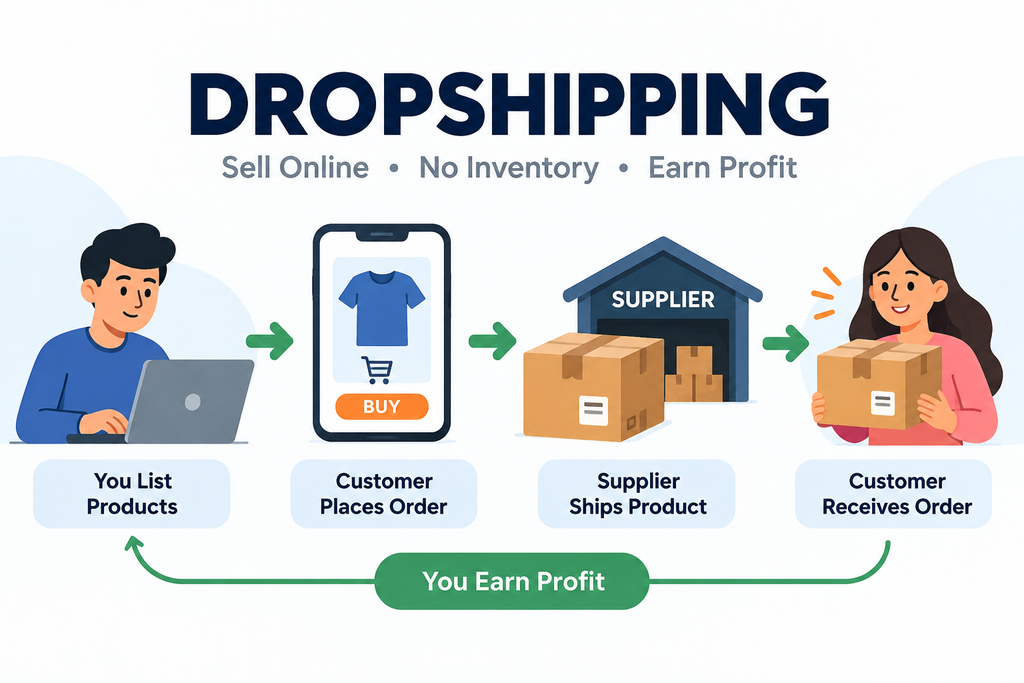
Dropshipping is an online business model where you sell products to customers without keeping the products in your own inventory.
When a customer purchases a product from your online store, you receive the order and then purchase the product from your supplier. The supplier prepares and ships the product directly to your customer.
For example, imagine you find a product from a supplier for $10. You list that product on your online store for $25. When a customer purchases it for $25, you pay the supplier $10 plus applicable shipping costs, and the supplier sends the product to the customer.
The difference between your revenue and your total costs can become your profit.
Simple Dropshipping Example
Suppose you sell a product for $30.
Your costs could be:
Product cost: $10
Shipping: $4
Advertising: $7
Other fees: $2
Your estimated profit would be:
$30 − $10 − $4 − $7 − $2 = $7
This shows why you should calculate all your costs before deciding whether a product is profitable.
How Does Dropshipping Work?
The dropshipping process is relatively simple.
You first choose a product and find a supplier who can provide and ship it. You then create an online store and add the product with your own images, description, price, and other information.
After promoting your store, a customer places an order and pays you. You then submit the order to your supplier and pay the supplier for the product and shipping.
The supplier packages and ships the product directly to your customer.
The basic process is:
Product research → Supplier → Online store → Marketing → Customer order → Supplier fulfillment → Customer delivery
You don’t need to physically store the products, but you are still responsible for your store, marketing, customer support, refunds, and overall customer experience.
How Can You Earn Money From Dropshipping?
The main way to make money from dropshipping is by selling products at a price higher than your total cost.
However, your profit isn’t simply the difference between the product cost and selling price.
You need to consider:
Product Cost
This is the amount you pay your supplier for the product.
Shipping Cost
Depending on the supplier and destination, shipping can significantly affect your profit.
Advertising Cost
If you use Facebook, Instagram, TikTok, or Google Ads, advertising becomes part of your customer acquisition cost.
Payment and Platform Fees
Your payment provider and e-commerce platform may charge fees.
Refunds and Returns
Some customers may request refunds or returns, so you should consider these costs when calculating your potential profit.
Example
If you sell a product for $29.99 and your total costs are $18, your remaining amount before other business expenses is approximately $11.99.
Therefore, successful dropshipping requires good product research and careful financial management.
Best Dropshipping Apps and Platforms
Several tools can help you build and manage a dropshipping business.
Shopify
Shopify is an e-commerce platform that allows you to create an online store without building everything from scratch.
You can use it to manage:
• Products
• Orders
• Customers
• Store design
• Checkout
• Discounts
• Shipping settings
• Marketing integrations
Shopify can be used as the main platform where customers visit and purchase your products.
DSers
DSers is commonly used for AliExpress dropshipping.
It can help you import products, manage supplier information, process orders, and synchronize tracking information with your store.
A typical setup is:
Shopify → DSers → AliExpress Supplier → Customer
AliExpress
AliExpress is an online marketplace where you can find a wide variety of products from different sellers.
When using AliExpress for dropshipping, pay attention to:
• Supplier ratings
• Product reviews
• Number of orders
• Shipping options
• Delivery estimates
• Product quality
• Return policies
CJdropshipping
CJdropshipping is another platform that can be used for product sourcing and fulfillment.
It provides product sourcing and fulfillment services and can integrate with e-commerce platforms such as Shopify.
It can be useful when you want an alternative to the AliExpress-based model.
Canva
Canva isn’t a dropshipping platform, but it can be useful for creating marketing materials.
You can use it to create:
• Social media posts
• Product advertisements
• Store banners
• Promotional graphics
• Pinterest graphics
• Video content
TikTok, Instagram, and Facebook
Social media platforms can help you promote your products and bring visitors to your store.
Short-form videos are particularly useful for demonstrating how products work and showing their benefits.
How to Start Dropshipping Step by Step
Choose a Niche
The first step is choosing a niche.
A niche is a specific category or market that your store focuses on.
Examples include:
• Home accessories
• Fitness products
• Pet products
• Travel accessories
• Kitchen products
• Car accessories
• Phone accessories
• Fashion accessories
Instead of creating a store with hundreds of completely unrelated products, consider starting with a focused niche.
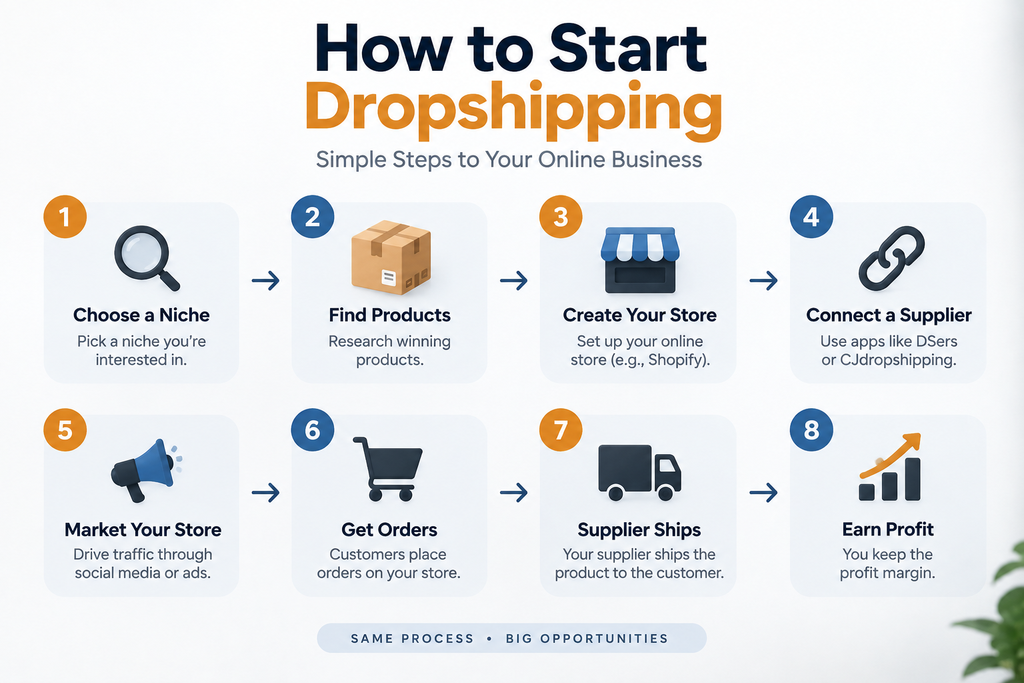
Find Winning Products
After selecting a niche, research products that people may actually want to buy.
Look for products that:
• Solve a problem
• Have reasonable demand
• Have good profit potential
• Are easy to demonstrate
• Are not extremely fragile
• Have reasonable shipping costs
• Have reliable suppliers
• Have good customer reviews
You can research products through social media, marketplaces, competitor stores, and product research tools.
Don’t select a product simply because it is trending. A product can receive millions of views and still fail to generate profitable sales.
Find a Reliable Supplier
Your supplier plays an important role in your business.
Before working with a supplier, check:
• Product reviews
• Supplier ratings
• Previous orders
• Shipping methods
• Delivery times
• Return policies
• Product quality
• Communication
It is also a good idea to order a sample before heavily advertising a product. This allows you to see the actual product and understand its packaging and quality.
Create Your Online Store
Once you have selected a product and supplier, create your online store.
Shopify is one option for creating the store.
Your store should include:
• Logo
• Brand name
• Homepage
• Product pages
• Contact page
• About page
• Privacy Policy
• Refund Policy
• Shipping Policy
• Terms and Conditions
Your store should look trustworthy and professional. Avoid simply copying a supplier’s entire product page.
Connect a Dropshipping App
After creating your store, connect a dropshipping platform such as DSers or CJdropshipping.
This can make it easier to:
• Import products
• Manage supplier information
• Process orders
• Synchronize tracking
• Manage fulfillment
Choose the platform based on your target market, supplier availability, shipping options, and overall costs.
Add Products to Your Store
Don’t simply copy the supplier’s title and description.
Create your own product presentation.
For example, instead of a generic title such as:
Multifunctional Portable Gadget 2026
you could create a clearer title that explains the benefit:
Portable 3-in-1 Travel Organizer
Your product page should clearly explain what the product does and why a customer might want it.
Set Your Prices
Pricing is an important part of dropshipping.
Before setting a price, calculate:
Product cost + Shipping + Payment fees + Advertising + Other expenses
Then compare your proposed price with competitors.
Your price should leave enough room for marketing expenses and unexpected costs.
Create High-Quality Product Pages
A professional product page should include:
Product Title
Make the title clear and easy to understand.
Product Images
Use clear, high-quality images that show the product from different angles.
Product Description
Explain what the product does and what problem it solves.
Benefits
Focus on the practical benefits rather than simply listing technical features.
Specifications
Include important information such as size, material, compatibility, or included items.
Shipping Information
Clearly explain expected shipping times and relevant conditions.
Frequently Asked Questions
Answer common questions customers may have before purchasing.
Call to Action
Make it easy for customers to purchase the product.
Set Up Payment and Shipping
Before launching your store, configure your payment and shipping methods.
This is especially important if you are operating from Pakistan and selling internationally. Payment availability, account requirements, supported countries, currencies, and settlement options can vary between providers.
Always verify the current requirements of your chosen payment provider before launching.
Start Marketing
Creating a store isn’t enough. You need visitors who are interested in your products.
You can use both organic and paid marketing.
Organic Marketing
Organic marketing doesn’t require paying for every individual visitor.
You can create:
• TikTok videos
• Instagram Reels
• YouTube Shorts
• Pinterest content
• Facebook content
• SEO content
For example, instead of simply posting:
Buy this product now!
you could create a short video demonstrating the product and showing how it solves a common problem.
Paid Advertising
You can also use paid advertising platforms such as:
• Meta Ads
• TikTok Ads
• Google Ads
• Pinterest Ads
Start with controlled testing rather than spending a large amount immediately.
Process Customer Orders
When a customer purchases a product, the order appears in your store.
You then send the order to your supplier through your dropshipping system.
The supplier prepares the product and ships it directly to the customer.
Your role is to make sure the order is processed correctly and the customer receives appropriate updates.
Track Shipments
Once the supplier ships the product, tracking information can be provided to the customer.
Good tracking and communication can reduce customer questions and improve the overall buying experience.
Provide Customer Support
Dropshipping doesn’t mean that you can ignore customers after receiving payment.
You should be prepared to handle:
• Shipping questions
• Damaged products
• Wrong products
• Delayed orders
• Refund requests
• Returns
• General product questions
Good customer service can help build trust and repeat purchases.
How to Find Winning Dropshipping Products
Finding the right product is one of the most important parts of dropshipping.
Product Demand
There should be enough people interested in the product.
You can use search trends, social media activity, marketplaces, and competitor research to understand demand.
Competition
Competition isn’t automatically bad, but you should understand who is already selling the product.
Look at competitor:
• Prices
• Product pages
• Advertisements
• Offers
• Reviews
• Shipping policies
Then identify opportunities to create a better customer experience.
Profit Potential
A product should have enough margin to cover marketing and other business expenses.
A product that costs $15 and sells for $18 may leave too little room for advertising and unexpected costs.
Shipping Time
Shipping time can have a major effect on customer satisfaction.
If customers have to wait a long time, clearly communicate the expected delivery period before they purchase.
Product Quality
A low-quality product can result in refunds, negative reviews, and customer complaints.
Always investigate the supplier and, where possible, test the product yourself.
Social Media Trends
TikTok, Instagram, YouTube Shorts, and other platforms can help you identify products that are attracting attention.
However, don’t assume that viral views automatically mean profitable sales.
How to Market Your Dropshipping Store
Organic Marketing
Create useful and entertaining content around your product.
Instead of repeatedly asking people to buy, show them:
• How the product works
• Problems it solves
• Different ways to use it
• Product demonstrations
• Comparisons
• Tips related to the niche
TikTok and Instagram Reels
Short videos can be useful for product discovery.
A simple video structure can be:
Problem → Product → Demonstration → Benefit → Call to Action
Facebook Marketing
Facebook can be useful for both organic content and paid advertising.
You can create a business page, publish product content, build an audience, and experiment with advertising.
SEO
Search engine optimization can help your store attract people who are actively searching for products or information.
You can optimize:
• Product titles
• Product descriptions
• Category pages
• Blog posts
• Images
• Internal links
Paid Advertising
Paid advertising can generate traffic faster, but it also carries financial risk.
Test your:
• Creative
• Audience
• Product
• Offer
• Landing page
before increasing your budget.
How Much Money Do You Need to Start Dropshipping?
There isn’t one fixed amount required to start dropshipping.
Your expenses can include:
Store Costs
You may need to pay for an e-commerce platform and domain.
Product Costs
You may need money to purchase products after receiving customer orders.
Marketing Costs
Advertising can become one of the largest expenses.
Sample Costs
Ordering samples can help you test product quality before selling aggressively.
Other Costs
You may also encounter payment fees, apps, transaction costs, refunds, and other business expenses.
Starting with a smaller budget means you should be especially careful about spending money on unnecessary apps and advertising.
Common Dropshipping Mistakes to Avoid
Choosing Products Without Research
Don’t choose a product simply because someone says it is a “winning product.”
Research demand, competition, pricing, supplier quality, and shipping.
Using Unreliable Suppliers
A supplier who provides poor-quality products or unreliable shipping can damage your business reputation.
Ignoring Shipping Times
Always communicate realistic delivery estimates.
Poor Product Pages
A product page with low-quality images, copied descriptions, and unclear information can reduce customer trust.
Spending Too Much on Advertising
Don’t spend your entire budget on ads before understanding whether your product and offer can convert profitably.
Ignoring Customer Service
Customers expect support when something goes wrong.
Advantages and Disadvantages of Dropshipping
Advantages
• Lower inventory requirements
• No need for your own warehouse
• Can be operated online
• Large variety of products available
• Easier to test different products
• Can potentially sell internationally
Disadvantages
• High competition
• Supplier dependency
• Shipping problems can affect your business
• Product quality may be difficult to control
• Advertising can become expensive
• Refunds and customer complaints can reduce profits
• Profit margins can be relatively low for some products
Dropshipping in 2026
The e-commerce landscape continues to change, and technology is making many parts of online selling easier to manage.
AI Tools for Dropshipping
AI tools can help with tasks such as:
• Product descriptions
• Marketing ideas
• Ad copy
• Customer-service drafts
• Content ideas
• Market research
AI should be treated as an assistant rather than a replacement for actual product and market research.
Automation
Modern dropshipping platforms can automate parts of:
• Product importing
• Order processing
• Inventory synchronization
• Tracking updates
• Customer notifications
Automation can save time, but you should still monitor orders and suppliers.
Social Commerce
Social platforms are increasingly important for product discovery.
Short-form videos, creators, influencers, and social-commerce features can help businesses reach potential customers without relying entirely on traditional search traffic.
Is Dropshipping Good for Beginners?
Dropshipping can be a way to learn e-commerce without purchasing a large amount of inventory upfront.
However, it should not be treated as a guaranteed way to make quick money.
A successful dropshipping business requires:
• Product research
• Supplier research
• Store-building skills
• Marketing
• Content creation
• Customer service
• Financial management
• Continuous testing
The goal should be to build a real e-commerce business rather than simply uploading random products and waiting for sales.
Conclusion
Dropshipping allows you to sell products online without maintaining traditional inventory yourself. You choose products, create an online store, attract customers, and work with suppliers who handle product fulfillment and shipping.
A typical setup can involve Shopify for your store, DSers and AliExpress or CJdropshipping for sourcing and fulfillment, Canva for marketing materials, and platforms such as TikTok, Instagram, Facebook, and Google for attracting customers.
The most important step is not simply creating the store. You need to select suitable products, work with reliable suppliers, calculate your real costs, create a trustworthy store, and develop a marketing strategy.
If you approach dropshipping as a real business and focus on testing, customer satisfaction, and profitability, you can build a more sustainable e-commerce operation over time.