
The Internet and networking are important parts of modern technology. The Internet connects computers, servers, mobile devices, and networks around the world. It allows people to share information, communicate with others, and use different online services.
Computer networking means connecting two or more devices so they can communicate and share data or resources. Networks can be small, such as a home network, or very large, such as the Internet.
Networking uses different devices, technologies, and protocols to move data from one device to another. Routers, switches, modems, servers, IP addresses, DNS, TCP/IP, HTTP, and Wi-Fi are some common parts of networking.
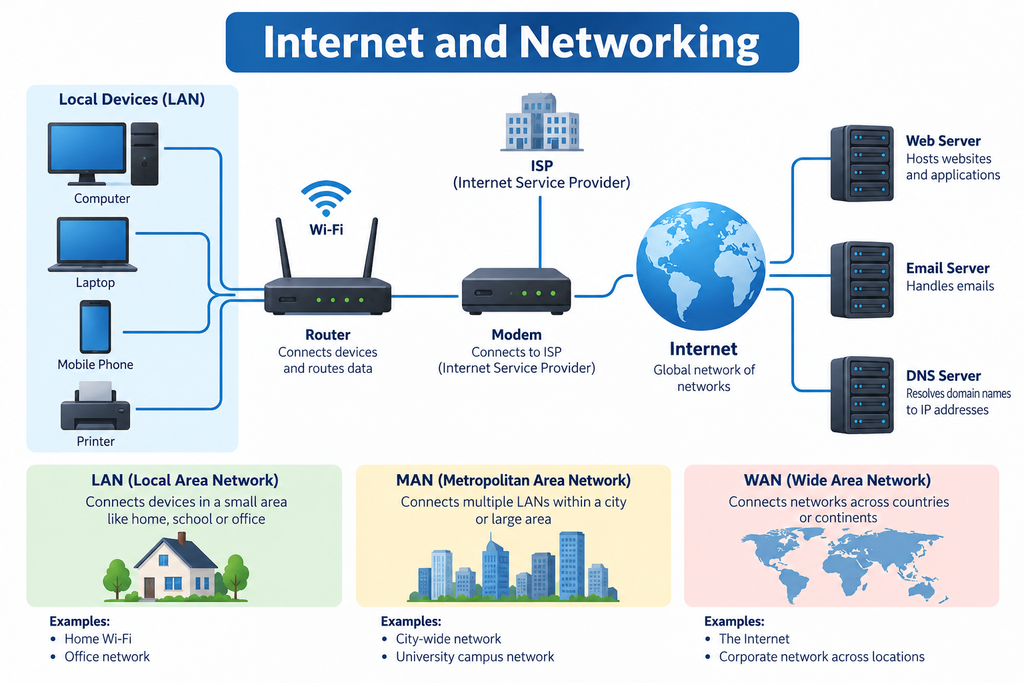
Networking Devices
Networking devices are hardware devices that help connect computers and other devices. They also help send, receive, and manage data across a network.
What is a router?
A router is a networking device that connects different networks. It receives data packets and sends them toward their destination.
Example: A home Wi-Fi router connects your home devices to the Internet.
What is a network switch?
A network switch connects multiple devices within the same network. It sends data to the correct device on the network.
Example: A switch can connect computers and printers in an office network.
What is a modem?
A modem helps connect a local network to an Internet service. It converts data into a form that can be transmitted through the communication system.
Example: A modem can be used with a broadband Internet connection.
What is a Gateway?
A gateway connects different networks or systems and allows them to communicate with each other.
Example: A gateway can connect a local network to another network.
What is a server?
A server is a computer or system that provides data, applications, or services to other devices.
Example: A web server stores website files and sends them to users when they open a website.
What is a network device?
A network device is a hardware device that helps send, receive, forward, or manage data on a network.
Examples: Router, switch, modem, gateway, and server.
Why is Computer Networking Important?
Computer networking makes communication and resource sharing between devices possible.
It is important for:
- Internet access
- Data sharing
- Communication
- Online services
- Cloud applications
- Business systems
- File and printer sharing
- Network security
FAQs about internet and networking
What is the Internet?
The Internet is a large global network that connects computers, servers, mobile devices, and other networks. It allows devices to communicate and exchange information.
What is computer networking?
Computer networking is the process of connecting two or more computing devices so they can communicate and share data or resources.
How Does the Internet Work?
The Internet sends information in small units called packets. These packets travel through networks and different devices such as routers and switches until they reach their destination.
The receiving device puts the packets together to form the original information.
What are the main types of computer networks?
The common types of computer networks include:
LAN
MAN
WAN
PAN
These networks are mainly classified according to their size, coverage area, and purpose.
What is LAN?
LAN stands for Local Area Network. It connects devices within a small area such as a home, school, office, or building.
Example: A network connecting computers in an office.
What is MAN?
MAN stands for Metropolitan Area Network. It covers a larger area than a LAN and can connect networks across a city or a large campus.
Example: A network connecting different offices across a city.
What is WAN?
WAN stands for Wide Area Network. It connects networks over large geographical areas such as cities, countries, or continents.
Example: The Internet is a well-known example of a large WAN.
What is PAN?
PAN stands for Personal Area Network. It connects devices around an individual.
Example: A smartphone connected to wireless headphones.
What is the difference between LAN, MAN, and WAN?
LAN covers a small area, such as a home or office.
MAN covers a larger area, such as a city or large campus.
WAN covers a very large area, such as different cities or countries.
What is a router?
A router is a networking device that connects different networks. It forwards data packets toward their destination.
What is a network switch?
A network switch connects multiple devices within the same network and forwards data to the correct device.
What is the difference between a router and a switch?
A router is mainly used to connect different networks, while a switch is mainly used to connect devices within the same network.
What is an ISP?
ISP stands for Internet Service Provider. An ISP is a company or service provider that gives users access to the Internet.
Example: A broadband or mobile Internet provider.
What is an IP address?
An IP address is a numerical address used to identify a device on a network and help deliver data to the correct destination.
Example: An IPv4 address can look like 192.168.1.1.
What is a MAC address?
A MAC address is an address used to identify a network interface. It is mainly used for communication within a local network.
What is the difference between an IP address and a MAC address?
An IP address helps identify and locate a device on a network, while a MAC address identifies the network interface of a device.
What is DNS?
DNS stands for Domain Name System. It helps convert human-readable domain names into IP addresses.
Example: DNS helps a device find the IP address connected with a website domain.
How Does DNS Work?
When a user enters a domain name, DNS helps find the IP address associated with that domain. The browser can then use that address to connect to the correct server.
What is a domain name?
A domain name is a human-readable name used to identify a website or Internet resource.
Example: example.com
Domain names are easier for people to remember than numerical IP addresses.
What is a network protocol?
A network protocol is a set of rules that tells devices how to communicate and exchange data over a network.
What is TCP?
TCP stands for Transmission Control Protocol. It is used to provide reliable communication between devices.
TCP helps make sure that data is delivered correctly and in the proper order.
What is UDP?
UDP stands for User Datagram Protocol. It provides connectionless communication and can be useful when fast data transmission is more important than guaranteed delivery.
What is TCP/IP?
TCP/IP stands for Transmission Control Protocol/Internet Protocol. It is a group of protocols used for communication across the Internet and computer networks.
TCP/IP helps with tasks such as addressing, routing, and data transmission.
What is HTTP?
HTTP stands for Hypertext Transfer Protocol. It is used to transfer information between web browsers and web servers.
What is HTTPS?
HTTPS stands for Hypertext Transfer Protocol Secure. It is the secure version of HTTP and uses encryption to protect communication.
What is Ethernet?
Ethernet is a wired networking technology. It uses network cables to connect devices and transfer data.
What is Wi-Fi?
Wi-Fi is a wireless networking technology that allows compatible devices to connect to a network without using physical network cables.
Examples: Ethernet cables, fiber-optic cables, and coaxial cables.
What is a Wired Network?
A wired network connects devices using physical cables.
Examples: Ethernet cables, fiber-optic cables, and coaxial cables.
What is a wireless network?
A wireless network allows devices to communicate without physical network cables.
Example: Wi-Fi networks.
What is network topology?
Network topology describes how devices and connections are arranged in a network.
What are the common types of network topology?
Common network topologies include:
Bus topology
Ring topology
Star topology
Mesh topology
What is bus topology?
In bus topology, multiple devices are connected to a main communication cable.
What is ring topology?
In ring topology, devices are connected in a circular arrangement.
What is Star Topology?
In star topology, multiple devices are connected to a central device, such as a switch or hub.
What is mesh topology?
In mesh topology, devices have multiple connections between them.
In a full mesh, every device is connected to other devices. In a partial mesh, only selected devices have multiple connections.
What is packet switching?
Packet switching is a method of sending data by dividing it into smaller packets. These packets travel through the network and are combined again when they reach the destination.
What is a server?
A server is a computer or system that provides data, applications, or services to other devices.
Examples: Web servers, file servers, and database servers.
What is client-server architecture?
Client-server architecture is a network model where clients request services or information from a central server.
Example: A web browser requests a webpage from a web server.
What is peer-to-peer networking?
Peer-to-peer networking is a network model where connected computers can communicate and share resources directly with each other.
A central server is not always required in a peer-to-peer network.
What is an Intranet?
An intranet is a private network used by an organization. It is normally available only to authorized users.
Example: An internal company network used by employees.
What is an extranet?
An extranet is a private network that allows selected external users or organizations to access certain resources.
Example: A company giving its business partners access to selected internal resources.
What is the difference between the Internet and the intranet?
The Internet is a global network that can be accessed by users around the world.
An intranet is a private network designed for an organization and its authorized users.
What is Network Security?
Network security means protecting networks, devices, and data from unauthorized access, attacks, and other security threats.
Common network security methods include:
Encryption
Access control
Firewalls
Authentication
What is cloud networking?
Cloud networking means using networking services and resources through cloud environments.
It can help organizations build flexible and scalable network systems.
What is a firewall?
A firewall monitors and controls network traffic based on security rules. It can allow or block network connections.
Conclusion
Internet and networking are the foundation of modern digital communication. The Internet connects networks around the world, while computer networking allows devices to communicate and share information.
Understanding basic concepts such as LAN, MAN, WAN, routers, switches, modems, servers, IP addresses, DNS, TCP/IP, HTTP, and Wi-Fi helps explain how modern networks work.
These basic networking concepts also provide a foundation for learning advanced topics such as cloud networking, cybersecurity, network security, and modern network architecture.