
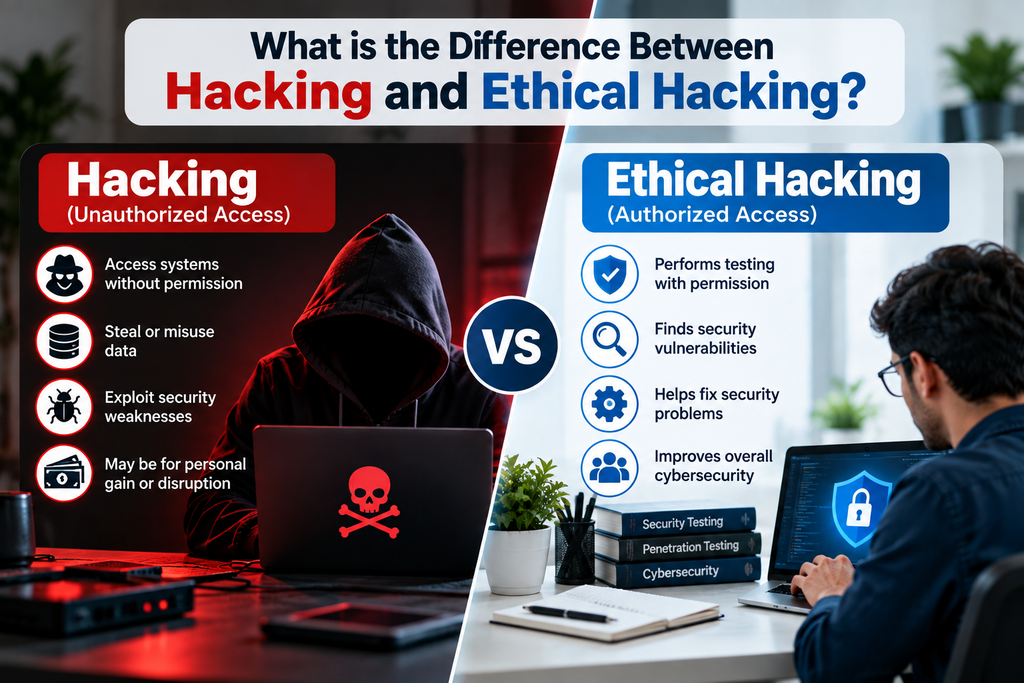
Hacking vs. ethical hacking may involve similar techniques, but the purpose and permission behind them are very different. Hacking can involve unauthorized access to systems or data, while ethical hacking is performed with permission to find and fix security vulnerabilities. In this guide, you’ll learn the key differences between hacking and ethical hacking, how they work, common types of hackers, and why ethical hacking is an important part of cybersecurity.
What Is Hacking?
Hacking is the process of finding and using weaknesses in a computer system, network, website, application, device, or digital account.
These weaknesses can come from things such as
- Weak passwords
- Poor security settings
- Software bugs
- Outdated software
- Other security problems
The word “hacking” describes the technical activity itself. However, whether that activity is legal or harmful depends on factors such as permission, purpose, and what the person does after gaining access.
How Does Hacking Work?
A hacker may search for weaknesses in websites, software, networks, accounts, or devices.
If a weakness is found, it may be used to:
- Access a system
- View or obtain information
- Change data
- Interfere with a service
- Take advantage of a security weakness
The techniques can vary depending on the target. They may include exploiting software vulnerabilities, taking advantage of weak authentication, social engineering, or other attack methods.
Why Do Hackers Hack?
Hackers can have different reasons for attacking a system.
Some may be looking for:
- Financial gain
- Sensitive information
- Personal or business data
- Service disruption
- Espionage
- Security research
- Personal curiosity
So, the reason behind the activity is an important part of understanding whether the hacking is malicious, unauthorized, or related to security research.
Common Types of Hacking
Hacking can target different parts of a digital system, including:
- Computer networks
- Websites
- Web applications
- Mobile applications
- Online accounts
- Individual users
- Digital devices
The technical knowledge used in hacking can sometimes be similar to the knowledge used by ethical hackers. The major difference is how that knowledge is used and whether the person has permission.
What Is Ethical Hacking?
Ethical hacking is the authorized process of finding and testing security weaknesses before they can be exploited by malicious attackers.
An ethical hacker works with permission from the owner of the system or website being tested. Before testing begins, the organization usually defines what can be tested, how it can be tested, and what rules the tester must follow.
How Does Ethical Hacking Work?
An organization may hire or authorize a security professional to test its systems and look for weaknesses.
The ethical hacker performs security tests within the agreed scope and records the problems they find.
The goal is not to steal data or damage the system. Instead, the findings are shared with the organization so it can fix security problems and improve its defenses.
What Does an Ethical Hacker Do?
An ethical hacker looks for security weaknesses within an approved scope.
Depending on the security assessment, they may test:
Networks
Websites
Web applications
Login systems
Authentication mechanisms
Other parts of an organization’s digital infrastructure
After the testing is complete, the ethical hacker reports the findings to the organization so the identified problems can be addressed.
Why Is Ethical Hacking Important?
Security weaknesses can sometimes remain hidden until a real attacker discovers them.
Ethical hacking gives organizations a chance to find these weaknesses earlier. It can help them:
- Understand their security problems
- Find vulnerabilities
- Fix security weaknesses
- Improve security controls
- Reduce the risk of certain cyber attacks
Hacking vs Ethical Hacking: Key Differences
The biggest difference between hacking and ethical hacking is not always the technical skill involved. It is how, why, and with whose permission those skills are being used.
| Factor | Hacking | Ethical Hacking |
| Authorization | Usually unauthorized | Requires permission |
| Main purpose | May involve exploitation or harm | Finds security weaknesses |
| Intent | Can be malicious or unauthorized | Defensive |
| Scope | Decided by the attacker | Defined by the organization |
| Data handling | May steal, change, or expose data | Findings are responsibly reported |
Difference in Authorization
Permission is one of the most important differences between the two.
An ethical hacker must have permission from the owner of the system or asset before testing it.
Without proper authorization, accessing a system can be considered unauthorized access, even if the person has strong technical skills.
Difference in Intent
Unauthorized attackers may try to:
- Steal information
- Cause damage
- Disrupt services
- Make money
- Exploit security weaknesses
An ethical hacker, on the other hand, performs security testing to find weaknesses and help improve the security of a system.
Difference in Purpose
The purpose of ethical hacking is to discover security problems and provide useful information to the organization.
Unauthorized hacking may use those same weaknesses for personal gain, data theft, disruption, or other forms of exploitation.
Difference in Scope
Ethical hacking is normally performed within a clearly defined scope.
The tester knows:
- Which systems can be tested
- Which methods can be used
- Which activities are allowed
- Which systems are outside the test
This helps prevent security testing from affecting systems or information that are outside the agreed scope.
Difference in Data Handling
Ethical hackers are expected to handle information responsibly.
If they find sensitive information or security problems during testing, they report the relevant findings to the organization rather than using the information for personal benefit.
Unauthorized attackers may steal, change, expose, or misuse the information they obtain.
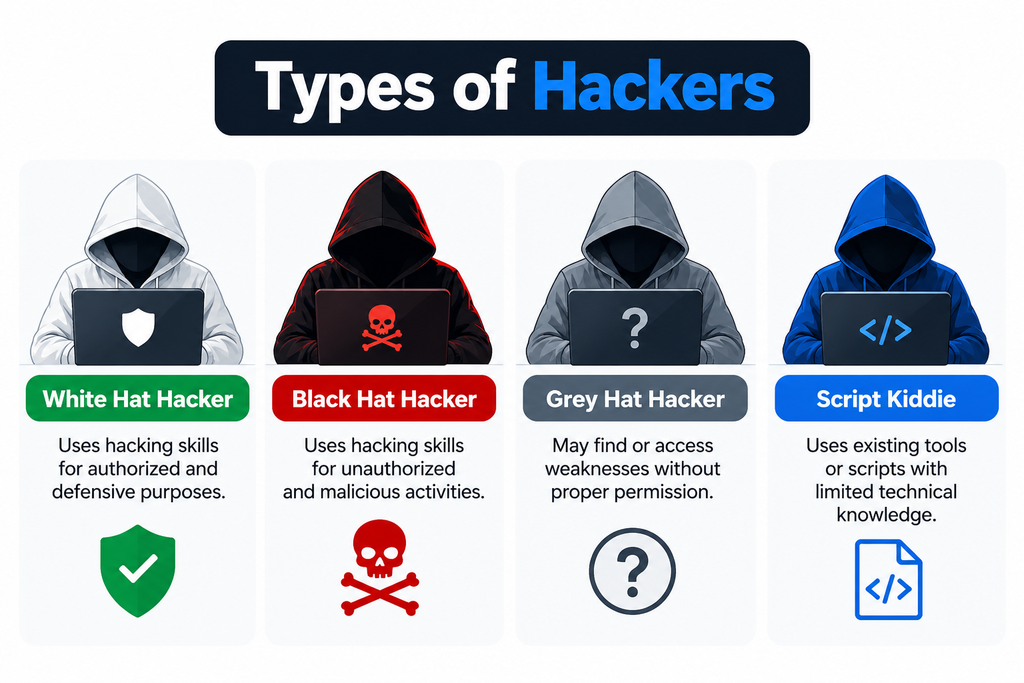
Types of Hackers
Hackers are often classified according to their purpose, methods, and whether they have permission to access a system.
White Hat Hackers
White hat hackers are security professionals who use their skills for authorized and defensive purposes.
They may test websites, networks, applications, or other systems to help organizations find and fix security vulnerabilities.
Black Hat Hackers
Black hat hackers are generally associated with unauthorized and malicious activities.
Their actions may include:
- Stealing data
- Spreading malware
- Making money through attacks
- Disrupting services
- Causing other types of harm
Grey Hat Hackers
Grey hat hackers fall somewhere between the traditional white hat and black hat categories.
They may find or access a security weakness without proper permission, even if their intention is not necessarily to cause harm.
However, accessing a system without permission can still create legal and security problems.
Script Kiddies
Script kiddies generally have limited technical knowledge.
Instead of creating their own advanced attack methods, they often use existing scripts or tools made by other people to carry out attacks or experiments.
Similarities Between Hacking and Ethical Hacking
Although their purposes can be very different, hacking and ethical hacking can involve some of the same technical concepts.
Both Require Technical Knowledge
Knowledge of the following areas can be useful in both:
- Computer networks
- Operating systems
- Web applications
- Authentication
- Programming
- Scripting
- Security tools
The important difference is how that knowledge is used.
Both Look for Security Vulnerabilities
Both malicious attackers and authorized security testers may search for weaknesses in systems, applications, networks, or processes.
An ethical hacker looks for these weaknesses so they can be fixed, while a malicious attacker may try to exploit them.
Both Can Use Similar Attack Techniques
During an authorized security assessment, ethical hackers may use techniques similar to those used in real-world attacks.
For example, testing may involve:
- Credential attacks
- Social engineering
- Vulnerability exploitation
- Other controlled security tests
However, these activities must remain within the agreed scope of the security assessment.
Both Require an Attacker’s Mindset
An ethical hacker needs to think like a potential attacker.
By looking at a system from an attacker’s point of view, a security tester may find weaknesses that normal security checks could miss.
Advantages of Ethical Hacking
Ethical hacking can give organizations useful information about the security of their systems.
Improves Cybersecurity
Security testing can uncover weaknesses that might otherwise remain unnoticed.
Organizations can then use this information to improve their security controls.
Identifies Security Vulnerabilities
Ethical hackers can examine systems and applications to find vulnerabilities before they are potentially discovered and exploited by malicious attackers.
Helps Prevent Cyber Attacks
Finding and fixing security weaknesses can reduce certain security risks and make it harder for attackers to take advantage of known problems.
Protects Sensitive Data
Security testing can help identify weaknesses that could expose:
- Customer information
- Business data
- Passwords and credentials
- Other sensitive information
Limitations of Ethical Hacking
Ethical hacking is useful, but it also has some practical limitations.
Cost of Security Testing
Hiring qualified security professionals and carrying out proper security testing can be expensive.
This can be a challenge for smaller organizations with limited budgets.
Limited Testing Scope
An ethical hacker normally works within the systems and activities defined in the agreement.
If a vulnerability exists outside that scope, it may not be tested during the engagement.
Need for Proper Authorization
Security testing must always have clear permission and boundaries.
Without proper authorization, an activity that was intended as a security test could become unauthorized access.
Ethical Hacking and Penetration Testing
Penetration testing is a structured type of security assessment in which authorized testers try to find weaknesses in systems, networks, or applications.
What Is Penetration Testing?
Penetration testing involves controlled security tests designed to find vulnerabilities and see how a system might respond to potential attacks.
The testing is performed with permission and within an agreed scope.
How Does Penetration Testing Work?
A penetration test usually starts by defining:
- The targets
- The testing scope
- The goals of the test
- The allowed testing methods
The tester then performs the agreed security checks, documents the vulnerabilities found, and prepares a report for the organization.
Ethical Hacking vs Penetration Testing
The two terms are closely related, but they are not always interchangeable.
Ethical hacking is a broader term that covers authorized security activities, while penetration testing usually refers to a structured assessment designed specifically to test the security of a system or application.
Is Ethical Hacking Legal?
Ethical hacking is based on authorization.
A person performing a security test should have appropriate permission from the owner of the system or digital asset being tested.
Why Is Permission Important?
Permission clearly defines:
- What the ethical hacker can test
- Which actions are allowed
- Which systems are included
- Which activities are restricted
It also helps prevent the tester from accessing systems or information that are outside the agreed security assessment.
Authorized vs Unauthorized Access
Authorized access means a person has the required permission to access and test a system.
Unauthorized access means accessing a system without the required permission.
This distinction is one of the most important things to understand when learning ethical hacking.
Rules and Scope of Security Testing
A professional security assessment should clearly define important details such as:
- Which systems can be tested
- What testing methods are allowed
- When the testing can take place
- What activities are restricted
- How the findings should be reported
Clear rules help keep the security test controlled and within the agreed boundaries.
Skills Required for Ethical Hacking
Ethical hackers need knowledge of different areas of technology and cybersecurity.
Computer Networking
Understanding computer networks helps security professionals understand how devices communicate and where security weaknesses may exist.
Operating Systems
Knowledge of operating systems is important for understanding system settings, permissions, processes, and security controls.
Web Applications
Many security tests involve websites and web applications.
Ethical hackers need to understand how these applications work and how common security vulnerabilities can affect them.
Programming and Scripting
Programming and scripting skills can help ethical hackers automate tasks, understand how applications work, and solve technical problems more efficiently.
Security Tools
Security professionals use different tools to:
- Test systems
- Find vulnerabilities
- Monitor activity
- Analyze security problems
- Document findings
Vulnerability Assessment
An ethical hacker should understand how to find, evaluate, and prioritize security vulnerabilities.
This helps organizations focus on the problems that need attention.
Ethical Hacking vs Cybersecurity
Ethical hacking and cybersecurity are closely connected, but they are not exactly the same thing.
What Is Cybersecurity?
Cybersecurity is the broader of protecting computers, networks, applications, devices, and data from security threats.
What Is Ethical Hacking?
Ethical hacking focuses on authorized testing to find security weaknesses that could potentially be exploited by attackers.
How Ethical Hacking Supports Cybersecurity?
Ethical hackers can find vulnerabilities through controlled testing and report them to the organization.
This information can then be used as part of the organization’s wider cybersecurity efforts.
Career Opportunities in Ethical Hacking
Cybersecurity includes several career paths for people with technical and security skills.
Ethical Hacker
An ethical hacker performs authorized security assessments to find weaknesses in systems and applications.
Penetration Tester
A penetration tester performs structured security tests on approved systems, networks, and applications.
Security Analyst
A security analyst may:
- Monitor systems
- Investigate security events
- Review security alerts
- Help maintain security controls
Vulnerability Assessment Specialist
A vulnerability assessment specialist focuses on finding and evaluating weaknesses across systems and applications.
Cybersecurity Professional
Cybersecurity professionals can work in different areas, including:
- Security operations
- Network security
- Application security
- Risk management
- Defensive security
Frequently Asked Questions
What is the difference between hacking and ethical hacking?
The main difference is permission and purpose. Ethical hacking is performed with permission to find and help fix security weaknesses, while unauthorized hacking may involve accessing or exploiting systems without permission.
What is ethical hacking?
Ethical hacking is the authorized process of testing systems, networks, websites, applications, or other digital assets to find security vulnerabilities.
Is ethical hacking legal?
Ethical hacking can be performed legally when the tester has proper authorization and follows the agreed scope and rules of the security assessment.
What is a white hat hacker?
A white hat hacker is a security professional who uses hacking techniques for authorized and defensive purposes.
What is a black hat hacker?
A black hat hacker is generally associated with unauthorized or malicious activities involving computer systems, networks, applications, or data.
What is penetration testing?
Penetration testing is an authorized security assessment where testers try to find weaknesses in systems, networks, or applications.
Is ethical hacking part of cybersecurity?
Yes. Ethical hacking is one area of cybersecurity. It helps organizations find security weaknesses through authorized testing and use that information to improve their overall security.
Conclusion
Hacking and ethical hacking can involve many of the same technical concepts, but they are not the same.
The key differences are authorization, intent, purpose, scope, and how data is handled.
Ethical hackers work within an agreed scope and use their skills to find security weaknesses so organizations can fix them. Understanding this difference is a good starting point for anyone interested in cybersecurity, penetration testing, or information security.