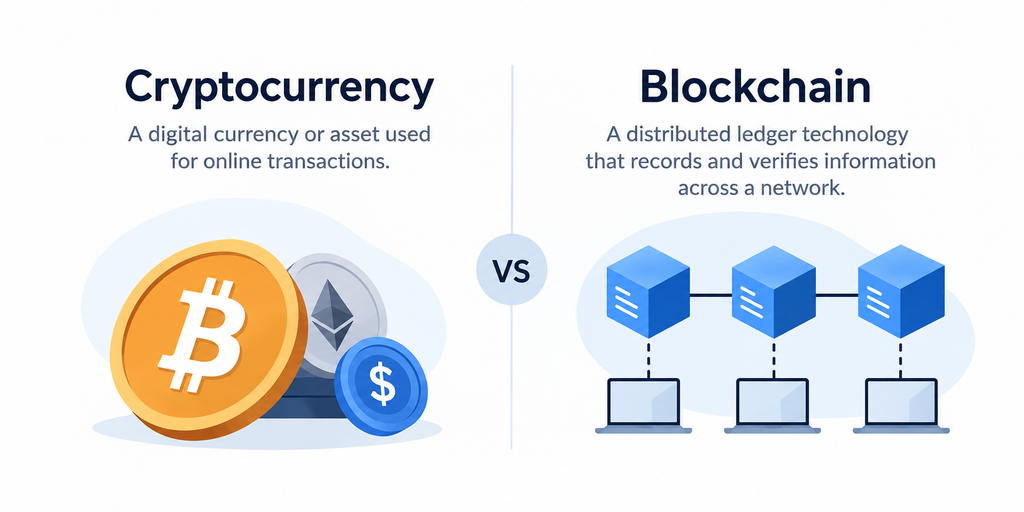
Cryptocurrency and blockchain are closely related terms, but they are not the same thing. Cryptocurrency is a digital asset or form of digital currency, while blockchain is the technology that can be used to record and verify transactions and other types of information.
The easiest way to understand the relationship is to think of blockchain as the underlying technology and cryptocurrency as one of its applications. For example, Bitcoin uses blockchain technology to record its transactions.
However, blockchain is not limited to digital currencies. It can also have applications in areas such as supply chain management, financial services, healthcare, smart contracts, voting systems, and secure data management.
What is Blockchain?
Blockchain is a digital system used to store and record information. Instead of keeping the information on one central computer, it can be shared across many computers in a network.
The information is stored in groups called blocks. These blocks are connected to each other, forming a chain. This is where the name “blockchain“ comes from.
Blockchain uses special security methods called cryptography to protect the information. Once information is added to the blockchain, changing it can be very difficult because the blocks are connected and verified by the network.
How does blockchain work?
When a transaction or other information is submitted to a blockchain network, participating computers process and verify it according to the rules of that network.
The consensus mechanism helps network participants agree on the correct state of the ledger. Once the information is accepted, it can be included in a block and linked to previous records.
The exact way a blockchain works depends on the type and design of the network.
What is blockchain used for?
Blockchain technology can be used for many other purposes, not just cryptocurrency.
Its potential uses include the following:
• Supply Chain Management
• Financial Services
• Health care records
• Smart contracts
• Voting system
• Digital asset management
• Secure data management
This wide range of uses is a major reason why blockchain and cryptocurrency should not be considered the same thing or synonymous.
What is Cryptocurrency?
Cryptocurrency is a digital or virtual form of currency that uses cryptographic techniques to secure transactions and control the transfer of digital value.
Unlike traditional currencies that are typically managed by centralized financial institutions, many cryptocurrencies operate through decentralized networks.
Bitcoin is one of the most famous examples. Other cryptocurrencies also use blockchain or similar distributed ledger technologies to keep a record of transactions.
How does cryptocurrency work?
When a person sends cryptocurrency to another user, the transaction is processed by the relevant network.
A transaction contains information about the transfer and is verified according to the rules of that network. Once accepted, the transaction can become part of a permanent transaction record.
Users typically interact with their cryptocurrency through a digital wallet. A wallet can allow users to send, receive, and manage their digital assets.
Cryptographic keys are important because they help authenticate transactions and provide access to cryptocurrency holdings.
What is the relationship between Blockchain and Cryptocurrency?
Blockchain and cryptocurrency are interconnected because blockchain can provide the infrastructure for recording cryptocurrency transactions.
For example, when Bitcoin is transferred from one user to another, the transaction can be recorded on the Bitcoin blockchain. The blockchain provides a distributed record, while the Bitcoin represents the digital asset being transferred.
This means that cryptocurrency blockchain technology can be applied.
However, this relationship is not necessarily the other way around. Blockchain does not necessarily have to be a cryptocurrency. Blockchain systems can also be designed for other purposes where distributed and verifiable records are useful.
Blockchain vs. Cryptocurrency: Key Differences
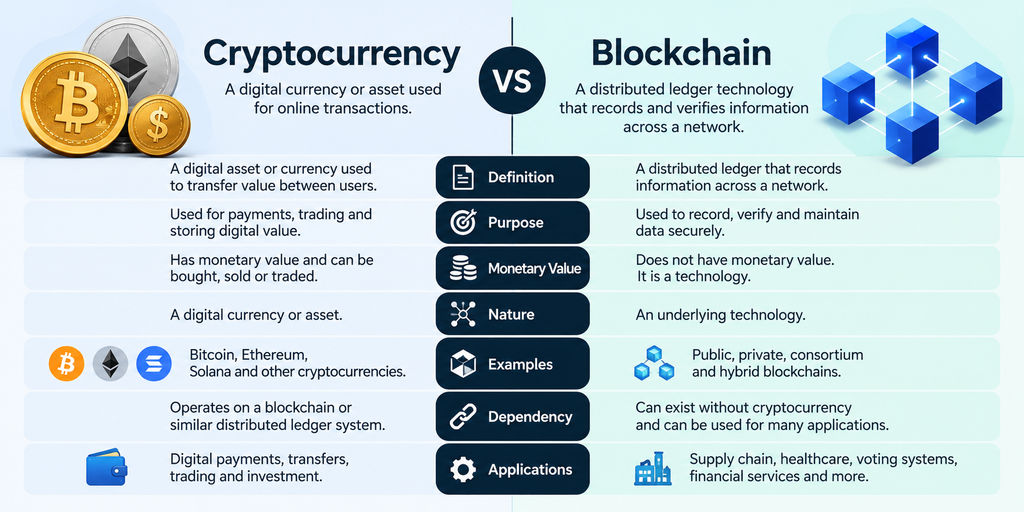
Although the two concepts are closely related, they differ in their purpose, nature, value, and application.
Definition
Blockchain is a technology used to maintain a distributed record of information.
Cryptocurrency is a digital asset or digital currency that can be transferred between users via a digital network.
Purpose
The purpose of blockchain is to provide a system for recording, verifying, and maintaining information across a network.
Cryptocurrency is primarily designed to represent and transfer digital value.
Tax value
Blockchain itself is a technology and does not represent any monetary value in itself.
Cryptocurrency can have monetary or market value and can be transferred between users.
Technology
Blockchain is the infrastructure that can support digital assets and other applications.
Cryptocurrency works through a blockchain or some other type of distributed ledger system, depending on the specific digital currency.
Transparency
Blockchain networks can provide transparent records depending on their design and access rules.
Cryptocurrency transactions can be seen on a public blockchain while the people involved are represented by digital addresses rather than their real names.
Applications
Cryptocurrency is primarily associated with digital payments, transfers, trading, and other financial activities.
Blockchain has applications in many sectors, including supply chain, healthcare, financial services, data management, and smart contracts.
Dependence
Cryptocurrency relies on blockchain technology to record and verify transactions.
Blockchain can work without cryptocurrency and can be used for applications that do not involve digital money.
Comparison of blockchain and cryptocurrency
Feature
Blockchain
Cryptocurrency
Nature
Technology
Digital asset or currency
Main objective
Recording and verifying information.
Transferring and representing digital value.
Monetary value
It has no monetary value in itself.
There may be a market value.
Basic use
In many different industries.
Digital financial transactions
Relationship
Can support cryptocurrency.
Uses blockchain technology.
Examples
Public, private, consortium, and hybrid networks
Bitcoin, Ether, and other cryptocurrencies
Is Bitcoin a cryptocurrency or a blockchain?
Bitcoin is a cryptocurrency.
It is not the name of the underlying technology itself. Bitcoin uses blockchain technology to record and verify its transactions.
Here’s a simple way to understand it:
Bitcoin is a digital asset, while the Bitcoin blockchain is the distributed ledger that records Bitcoin transactions.
Does blockchain exist without cryptocurrency?
Yes, blockchain can exist without cryptocurrency.
A blockchain can be built to maintain records or verify information without being used as a digital payment system.
For example, organizations can use blockchain for the following purposes:
• Supply chain tracking
• Data verification
• Records management
• Smart contracts
• Tax practice
• Other systems that require distributed records
What is blockchain used for besides cryptocurrency?
Blockchain can have multiple uses in different industries.
Supply Chain Management
Blockchain can be used to record information as products move through different stages of the supply chain. A shared record helps all participants track and verify information about products and their stages.
Tax services
In addition to digital currency, blockchain can be used in financial systems for transaction records, digital assets, and other processes where multiple participants need access to trusted information.
Healthcare
Blockchain has been discussed as a potential technology for managing and verifying certain types of healthcare information where data integrity and controlled access are important.
Smart contracts
Smart contracts are programs or protocols that can run on blockchain networks. They help automate certain actions when predefined conditions are met.
Voting systems
Blockchain has also been proposed for voting-related applications because it can provide a distributed record of information. However, a real voting system involves additional requirements related to privacy, security, accessibility, and governance.
Real estate records
Blockchain could potentially be used to maintain and verify records related to property ownership and transactions.
Why is blockchain important for cryptocurrency?
Blockchain provides a way to record cryptocurrency transactions across a distributed network.
Without relying on a central authority, computers in a network use network rules and authentication mechanisms to maintain a shared record.
Cryptographic methods also help protect transaction information and control access to digital assets.
Benefits of Blockchain Technology
Blockchain can provide several features that make it useful for certain applications.
Transparency
Depending on the network design, participants may be able to inspect and verify recorded information.
Distributed records
Information can be maintained across multiple computers rather than relying on a single database.
Data Integrity
Cryptographic mechanisms and network authentication can make unauthorized modifications more difficult.
Traceability
Blockchain can create a record that allows transactions or other information to be tracked through the system.
Minimal need for intermediaries
Some blockchain applications can reduce or eliminate the need for intermediary systems and individuals (middlemen) by allowing participants to communicate directly through a shared system.
FAQs
Is blockchain the same as cryptocurrency?
No. Blockchain is a technology for recording and verifying information, while cryptocurrency is a digital asset or currency. Cryptocurrency uses blockchain as its underlying infrastructure.
Is cryptocurrency based on blockchain?
Many cryptocurrencies use blockchain technology or a similar distributed ledger system. Bitcoin, for example, uses a blockchain to record its transactions.
What is the main difference between blockchain and cryptocurrency?
Blockchain is the technology used for distributed record keeping, while cryptocurrency is a digital asset that can use this technology to transfer and record value.
Can blockchain be used without cryptocurrency?
Yes, blockchain can be used for supply chain management, data management, smart contracts, financial services, and other systems that require distributed records.
Is Bitcoin a blockchain?
Bitcoin is a cryptocurrency. It operates through a blockchain network that records Bitcoin transactions.
What is blockchain technology used for?
Blockchain technology can be used for cryptocurrency as well as supply chains, financial services, smart contracts, data management, and other forms of distributed record keeping.
Is cryptocurrency the only use of blockchain?
No, cryptocurrency is a major application, but blockchain can also be used in areas outside of digital currencies, including supply chain management, financial services, healthcare, and record keeping.
Conclusion
Blockchain and cryptocurrency are closely related, but they represent different concepts.
Blockchain is a distributed ledger technology that can be used to record and verify information across a network. Cryptocurrency is a digital asset or form of digital currency that can use a blockchain to record and transfer value.
The easiest way to remember this difference is that blockchain is the underlying technology, while cryptocurrency is an application of this technology.
Blockchain can also be used beyond cryptocurrency, giving it potential applications in areas such as supply chains, financial services, healthcare, smart contracts, and digital records management.