
Blockchain is one of the most important technologies to emerge in the digital world. It has become especially popular because of Bitcoin, cryptocurrency, NFTs, smart contracts, and Web3.
In simple words, blockchain is a digital record-keeping technology that stores information in connected blocks. Instead of keeping the entire record in one central place, many blockchain networks distribute copies of the information across multiple computers.
This makes blockchain useful for creating records that are transparent, traceable, and difficult to change after they have been confirmed.
FAQs
What is blockchain in simple words?
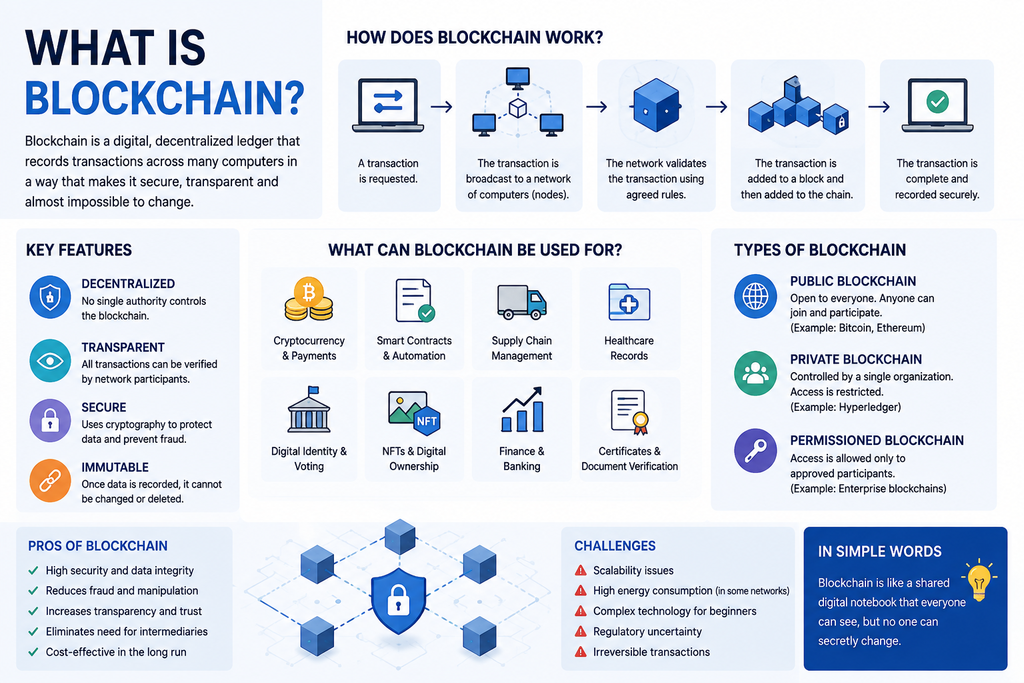
Blockchain is a digital ledger that records transactions and information in connected blocks. The records can be shared across a network, making unauthorized changes difficult.
How does blockchain work?
A transaction is submitted to a blockchain network. Network participants verify the transaction, approved transactions are grouped into a block, and the block is added to the existing blockchain.
Why is blockchain called a blockchain?
The name comes from its structure. Information is stored in blocks, and each block is connected to previous blocks, creating a continuous chain of records.
What is a block in blockchain?
A block is a collection of information recorded on a blockchain. Depending on the network, it may contain transactions, timestamps, cryptographic information, and other data.
What is a blockchain ledger?
A blockchain ledger is a digital record of transactions or information maintained by a blockchain network. It can be distributed among many computers rather than controlled by one central database.
Is blockchain the same as Bitcoin?
No. Bitcoin is not blockchain. Bitcoin is a cryptocurrency that uses blockchain technology to record transactions. Blockchain itself can be used for many other applications.
Who invented blockchain?
The concept of a blockchain-like system existed before Bitcoin, but Bitcoin’s creator, Satoshi Nakamoto, introduced the blockchain architecture used by Bitcoin in 2008 and 2009.
The real-world identity of Satoshi Nakamoto remains unknown.
Why was blockchain created?
Blockchain technology was designed to enable digital transactions and record keeping without requiring a central authority to maintain and verify the entire system.
Bitcoin was the first major practical implementation of this idea.
What is decentralization in blockchain?
Decentralization means that control and data are distributed among multiple participants instead of being controlled entirely by one organization or computer.
Why is decentralization important?
Decentralization can reduce dependence on a single point of control or failure. Multiple participants can help maintain and verify the network according to its rules.
What is a centralized system?
A centralized system is controlled primarily by one organization or authority.
For example, a traditional bank generally manages its own centralized database of customer accounts and transactions.
What is a decentralized system?
A decentralized system distributes control or record keeping among multiple participants.
A public blockchain can allow many independent computers to participate in maintaining the network.
What is a blockchain node?
A node is a computer connected to a blockchain network. Depending on its role, it may store blockchain data, verify transactions, communicate with other nodes, or participate in consensus.
What is blockchain consensus?
Consensus is the process through which participants in a blockchain network agree on which transactions or blocks should be accepted.
Different blockchains use different consensus mechanisms.
What is Proof of Work?
Proof of Work, or PoW, is a consensus mechanism that requires computers to perform computational work to help secure and validate the blockchain.
Bitcoin is the most famous example of a proof-of-work blockchain.
What is proof of stake?
Proof of Stake, or PoS, is a consensus mechanism where participants can help secure a blockchain by staking cryptocurrency according to the network’s rules.
It generally requires less energy than proof of work.
What is cryptocurrency?
Cryptocurrency is a digital asset that uses cryptographic technology to secure transactions and ownership.
Many cryptocurrencies use blockchain networks to record transactions.
How is cryptocurrency related to blockchain?
Blockchain provides the record-keeping infrastructure, while cryptocurrency is one type of digital asset that can use that infrastructure.
Bitcoin and many other cryptocurrencies depend on blockchain technology.
What is Bitcoin?
Bitcoin is a decentralized digital currency that allows users to transfer value through a peer-to-peer network without relying on a traditional central bank to process every transaction.
Its transactions are recorded on the Bitcoin blockchain.
What is Ethereum?
Ethereum is a blockchain platform that supports cryptocurrency, smart contracts, decentralized applications, and digital tokens.
Its native cryptocurrency is called Ether (ETH).
What is the difference between Bitcoin and Ethereum?
Bitcoin was primarily designed as a decentralized digital currency and store of value.
Ethereum is designed as a programmable blockchain platform that supports smart contracts and decentralized applications in addition to its native cryptocurrency.
What is a smart contract?
A smart contract is a computer program stored on a blockchain that can automatically execute predefined actions when specified conditions are met.
Are smart contracts legally binding?
Not necessarily. A smart contract is primarily software code. Whether it is legally enforceable depends on the specific arrangement, jurisdiction, and applicable laws.
What are decentralized applications?
Decentralized applications, commonly called dApps, are applications that use blockchain networks or smart contracts for some of their functions.
They can be used in finance, gaming, marketplaces, digital assets, and other areas.
What is Web3?
Web3 is a broad term for internet applications and infrastructure that incorporate technologies such as blockchains, smart contracts, decentralized networks, and digital assets.
What is a blockchain wallet?
A blockchain wallet is a tool that allows users to manage cryptographic keys and interact with blockchain networks.
It can be used to send, receive, and manage digital assets, depending on the wallet and blockchain.
Does a blockchain wallet actually store cryptocurrency?
Usually, cryptocurrency is not stored inside the wallet like physical cash.
The blockchain records ownership or balances, while the wallet manages the keys or credentials that allow a user to interact with those assets.
What is a private key?
A private key is a secret cryptographic value used to authorize certain blockchain transactions.
It should never be shared because someone who obtains it may be able to control the associated assets.
What is a public key?
A public key is a cryptographic value that can be shared. It is mathematically connected to a private key and is used for various forms of verification and identification.
What is a blockchain address?
A blockchain address is an identifier used to receive digital assets or interact with a blockchain network.
A blockchain address can generally be shared, while a private key must remain secret.
What is cryptography in blockchain?
Cryptography is the use of mathematical techniques to protect information.
Blockchain systems use cryptography for functions such as digital signatures, transaction verification, and data integrity.
What is hashing in blockchain?
Hashing converts information into a fixed-length digital value called a hash.
Blockchain systems use hashes to help link blocks and detect changes to recorded information.
Why are hashes important in blockchain?
A hash acts like a digital fingerprint of data. If the underlying data changes, its hash normally changes as well, making unauthorized modifications easier to detect.
Is blockchain secure?
Blockchain can provide strong security through cryptography, consensus mechanisms, and distributed networks.
However, blockchain is not automatically 100% secure. Wallets, exchanges, smart contracts, applications, and users can still have vulnerabilities.
Can blockchain be hacked?
A blockchain network can face attacks, but the difficulty depends on its design, size, consensus mechanism, and security.
In many cases, attacking a major decentralized blockchain directly can be extremely difficult. However, blockchain-related applications and user accounts can still be compromised.
Can someone change blockchain data?
Blockchain records are generally designed to be tamper-resistant. Once information has been confirmed, changing it can be extremely difficult on many networks.
However, the exact rules depend on the blockchain’s architecture and governance.
Are blockchain transactions reversible?
Many blockchain transactions are irreversible after confirmation.
If you send digital assets to the wrong address, recovering them may be impossible unless the recipient returns them or a specific recovery mechanism exists.
Can blockchain transactions be traced?
Yes, many public blockchain transactions can be traced.
Transaction activity on public blockchains can often be viewed and analyzed using blockchain explorers and other analytical tools.
Is blockchain anonymous?
Blockchain is not necessarily anonymous.
Many public blockchains are better described as pseudonymous because transactions are associated with addresses rather than directly displaying a person’s real name.
Is blockchain private?
It depends on the type of blockchain.
Public blockchains can allow anyone to view certain transaction information, while private or permissioned blockchains restrict access to approved participants.
What is a public blockchain?
A public blockchain is generally open for participation according to the network’s rules.
Examples include Bitcoin and Ethereum.
What is a private blockchain?
A private blockchain is controlled by a specific organization or group. Participation and access are usually restricted.
Private blockchains are often considered for business and enterprise applications.
What is a permissioned blockchain?
A permissioned blockchain requires users or organizations to have authorization before participating in certain network activities.
It can be useful when organizations need controlled access and shared records.
What are the advantages of blockchain?
Blockchain can offer several potential benefits:
• Transparency
• Tamper resistance
• Traceability
• Decentralized record keeping
• Automation through smart contracts
• Reduced dependence on certain intermediaries
• Digital ownership and asset tracking
What are the disadvantages of blockchain?
Blockchain also has limitations, including
• Scalability challenges
• Transaction fees
• Technical complexity
• Regulatory uncertainty
• Privacy concerns
• Energy consumption for some consensus mechanisms
• Irreversible transactions
Is blockchain expensive?
It depends on the blockchain and the type of transaction.
Some networks have relatively low fees, while others can become expensive when network demand increases.
Why do blockchain transaction fees change?
Transaction fees can change because of network congestion, demand, block capacity, transaction complexity, and the blockchain’s fee mechanism.
What is a blockchain transaction?
A blockchain transaction is an instruction recorded on a blockchain.
For cryptocurrencies, it may involve sending digital assets from one address to another.
How long does a blockchain transaction take?
The time varies significantly between blockchain networks.
Some transactions can be confirmed within seconds, while others may take longer depending on network conditions and the required number of confirmations.
What are blockchain confirmations?
A confirmation means that a transaction has been included in a block and additional blocks have subsequently been added to the chain.
More confirmations can provide greater confidence that a transaction will remain part of the accepted blockchain history.
What is a blockchain explorer?
A blockchain explorer is a website or application that allows users to search and view blockchain information.
Depending on the network, users can see transactions, wallet addresses, blocks, fees, and confirmations.
Examples include tools such as Etherscan for Ethereum and Blockchain.com Explorer for supported networks.
What is tokenization?
Tokenization means representing an asset, right, or value as a digital token on a blockchain.
Tokens can represent different types of assets or rights depending on how the system is designed.
What are blockchain tokens?
A token is a digital asset created and managed on a blockchain.
Tokens can represent currency, utility, ownership, access rights, collectibles, or other forms of value.
What is an NFT?
NFT stands for Non-Fungible Token.
An NFT is a blockchain-based token designed to have unique properties or identifiers. NFTs can be associated with digital art, collectibles, memberships, tickets, gaming items, and other assets.
What is DeFi?
DeFi, or Decentralized Finance, refers to financial applications built using blockchain technology and smart contracts.
DeFi applications can provide services such as lending, borrowing, trading, and asset management without relying entirely on traditional financial intermediaries.
What is blockchain mining?
Mining is the process used by certain Proof of Work blockchains to help validate transactions and add new blocks.
Bitcoin mining involves specialized computers performing computational work to compete for the right to add blocks.
Can anyone mine Bitcoin?
Technically, Bitcoin mining is open to participants, but profitable mining generally requires specialized hardware, electricity, infrastructure, and efficient operations.
Mining has become a highly competitive industry.
What is staking in blockchain?
Staking involves committing cryptocurrency to support certain Proof of Stake blockchain operations according to the network’s rules.
Participants may receive staking rewards, although staking also involves risks and conditions that vary by network.
How is blockchain used in banking?
Banks and financial institutions can use blockchain-related technologies for areas such as
• Payments
• Settlement
• Asset tokenization
• Identity management
• Record keeping
• Cross-border transactions
The technology does not necessarily mean banks will disappear.
Can blockchain replace banks?
Blockchain is unlikely to simply replace all banks.
Instead, it may change how certain banking and financial services are delivered by improving settlement, payments, digital assets, and automated transactions.
How is blockchain used in supply chains?
Blockchain can help organizations create a shared record of information about products as they move through a supply chain.
This can improve traceability and transparency, provided the information entered into the system is accurate.
Can blockchain be used in healthcare?
Yes. Blockchain technology can potentially support healthcare data sharing, identity management, credentials, record verification, and administrative processes.
Healthcare applications must also address privacy, security, regulations, and interoperability.
Can blockchain prevent fraud?
Blockchain can make certain types of record manipulation and transaction fraud more difficult, but it cannot prevent every kind of fraud.
Scams, stolen keys, fraudulent information, phishing, and vulnerable applications can still cause problems.
Is blockchain environmentally friendly?
It depends on the blockchain.
Proof of work networks can consume substantial electricity because they require computational work. Proof-of-stake networks generally use much less energy for consensus.
Is blockchain faster than a traditional database?
Not necessarily.
For many centralized applications, a traditional database can be faster, simpler, and cheaper. Blockchain is most useful when its specific advantages, such as shared verification or decentralized control, are actually needed.
Does blockchain require the internet?
Most public blockchain networks depend on internet-connected computers to communicate and synchronize.
Without network connectivity, users generally cannot broadcast transactions to the wider blockchain network.
Can blockchain work without a bank?
Yes. Certain blockchain systems allow users to transfer digital assets directly between addresses without requiring a traditional bank to process the transaction.
However, users may still interact with exchanges, payment providers, banks, or other services when converting between blockchain assets and traditional currencies.
Is blockchain legal?
Blockchain technology itself is legal in many countries, but the legality of specific blockchain applications, cryptocurrencies, exchanges, tokens, and financial activities varies by jurisdiction.
Users should consider the laws and regulations applicable to their country.
Is blockchain the future?
Blockchain has the potential to remain important in areas involving digital ownership, decentralized coordination, shared records, tokenization, smart contracts, and financial infrastructure.
However, its success will depend on whether it provides meaningful advantages over traditional technologies.
Final Thoughts
Blockchain is a digital record-keeping technology that allows information to be stored and verified across a network. Its combination of cryptography, distributed records, consensus mechanisms, and connected blocks makes it different from traditional databases.
Although blockchain became famous because of Bitcoin, its applications now extend far beyond cryptocurrency. Smart contracts, DeFi, NFTs, tokenization, supply chains, digital identity, and financial technology are some of the areas where blockchain can be applied.
At the same time, blockchain is not a perfect solution for every problem. Scalability, transaction costs, security risks, privacy, regulation, and usability remain important challenges.
The simplest way to remember blockchain is this: it is a shared digital record book that uses technology and network rules to make records verifiable and difficult to manipulate.
As the technology continues to develop, blockchain may become an increasingly important part of digital finance, online ownership, automated agreements, and decentralized applications.
Related Post


Blockchain is explained really clearly here, especially for beginners. Thanks for sharing!