
Artificial Intelligence (AI) is one of the most important technologies of the modern world. It is already being used in smartphones, websites, search engine, education, healthcare, business, entertainment, and creative tools. But what exactly is AI, how does it work, and what can it actually do?
Below are some of the most common questions people ask about artificial intelligence, explained in simple and clear language.
What is AI?
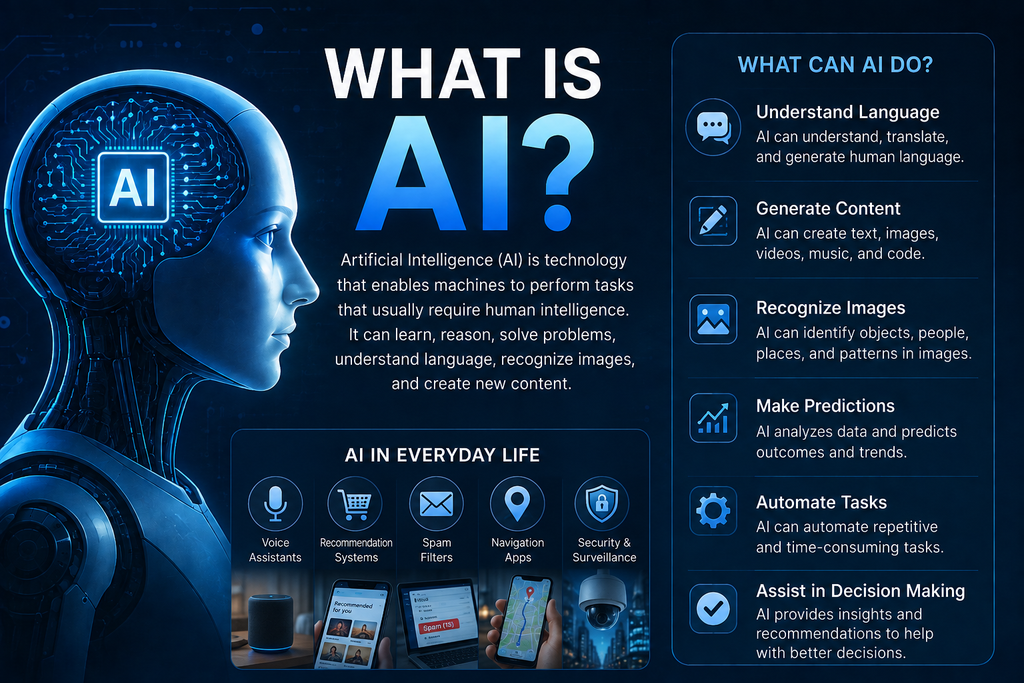
Artificial Intelligence (AI) is a technology that enables computers and machines to perform tasks that normally require human intelligence. These tasks can include understanding language, recognizing images, learning from information, solving problems, making predictions, and generating content.
How does Artificial Intelligence work?
AI systems are trained using large amounts of data. During training, an AI model identifies patterns and relationships in that data. When you give it a question, image, sound, or instruction, it uses what it has learned to produce an appropriate response or result.
Is AI the same as a robot?
No. AI and robots are different things. AI is software or intelligence, while a robot is a physical machine. A robot can use AI to understand its surroundings and make decisions, but not every AI system has a physical body.
What are some everyday examples of AI?
You may already use artificial intelligence every day without realizing it. Google Search, voice assistants, recommendation systems, spam filters, facial recognition, navigation apps, chatbots, and personalized advertisements can all use different forms of AI.
What is generative AI?
Generative AI is a type of artificial intelligence that can create new content based on a user’s instructions. It can generate text, images, audio, video, presentations, and computer code.
Popular examples include ChatGPT for text generation, Adobe Firefly for AI image and creative generation, Canva AI for design and content creation, and Midjourney for AI-generated images.
What is an AI image generator?
An AI image generator is a tool that creates images from written instructions, commonly called prompts. You can describe what you want, and the AI generates an image based on that description.
For example, tools such as Adobe Firefly, Midjourney, Canva AI, and DALL·E can be used to create illustrations, realistic scenes, artwork, product concepts, and other visual content.
Can AI create realistic images?
Yes. Modern AI image generators can produce highly detailed and realistic images. They can generate things such as people, landscapes, buildings, products, food photography, and fictional scenes.
However, AI-generated images can sometimes contain mistakes, particularly with hands, text, small details, or unusual objects.
What is an AI text generator?
An AI text generator creates written content based on a user’s instructions. It can help with articles, summaries, explanations, ideas, descriptions, scripts, and other forms of writing.
Examples include ChatGPT, Google Gemini, Claude, and Microsoft Copilot.
Can AI write an entire article?
Yes. AI can generate a complete article from a topic or detailed prompt. However, the content should be reviewed, fact-checked, and edited before publication because AI can occasionally produce inaccurate or outdated information.
What is an AI video generator?
An AI video generator uses artificial intelligence to create or modify video content. Depending on the tool, users can generate videos from text prompts, images, scripts, or existing footage.
Examples include Runway, Adobe Firefly, and other generative video platforms that can help create scenes, animations, and visual effects.
What is an AI voice generator?
An AI voice generator creates artificial speech from written text. It can produce voices for videos, advertisements, educational content, audiobooks, presentations, and accessibility applications.
Examples include tools such as ElevenLabs and other AI voice platforms.
Can AI generate music?
Yes. AI music tools can generate songs, melodies, instrumental tracks, and other forms of audio from prompts or musical instructions.
These tools can be useful for content creators, video producers, musicians, and advertisers who need original background music or audio ideas.
Can AI understand human language?
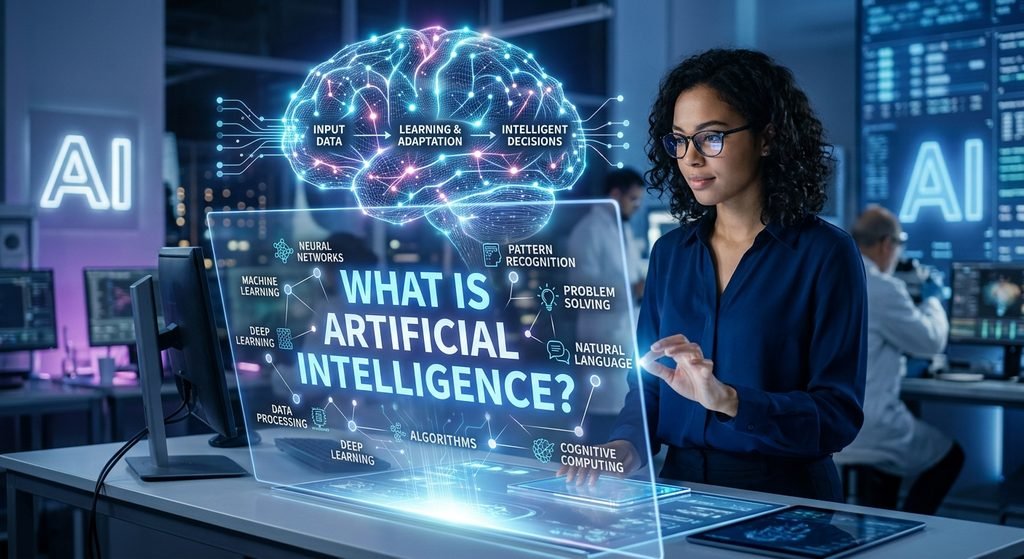
AI systems can process and generate human language using Natural Language Processing (NLP). This allows AI applications to understand questions, translate languages, summarize information, answer prompts, and communicate with users.
Can artificial intelligence learn by itself?
Artificial intelligence can learn patterns from data during training, but it does not learn exactly like a human. Most AI systems require carefully designed training processes, large datasets, computing resources, and human supervision.
Some systems can also improve through machine learning techniques and feedback.
What is Machine Learning?
Machine Learning (ML) is a branch of AI that allows computers to learn patterns from data instead of being explicitly programmed for every individual task.
For example, an email system can learn from previous examples to identify whether a new message is likely to be spam or legitimate email.
What is deep learning?
Deep learning is a specialized area of machine learning that uses artificial neural networks with multiple layers. It is particularly important for tasks involving images, speech, language, and complex pattern recognition.
What is an AI chatbot?
An AI chatbot is a computer program that communicates with people using natural language. Modern AI chatbots can answer questions, explain concepts, summarize documents, generate content, and assist with many different tasks.
ChatGPT, Google Gemini, Claude, and Microsoft Copilot are examples of artificial intelligence assistants that use advanced language models.
Can AI answer every question correctly?
No. artificial intelligence can provide useful answers, but it can also make mistakes. Sometimes it may generate information that sounds convincing but is incorrect, incomplete, or outdated.
For important topics, AI-generated information should be verified using reliable sources.
Can AI replace humans?
Artificial intelligence can automate many tasks, but it does not simply replace humans in every situation. Its impact depends on the type of work, industry, and task.
Artificial intelligence is often most useful when it works alongside people by handling repetitive tasks while humans provide judgment, creativity, communication, and decision-making.
Will AI take people’s jobs?
AI is likely to change many jobs rather than simply eliminate all employment. Some repetitive tasks may become automated, while new roles and responsibilities can emerge around AI.
Workers who learn how to use artificial intelligence effectively may be able to improve their productivity and efficiency.
Is AI dangerous?
AI itself is a technology, but its risks depend on how it is designed, deployed, and used. Potential concerns include misinformation, privacy problems, biased decisions, cybersecurity risks, copyright issues, and misuse of generated content.
Responsible development and appropriate human oversight are therefore important.
Can AI have emotions?
AI can produce language that appears emotional, but current AI systems do not have human emotions in the ordinary sense. When an AI says that it is happy, worried, or excited, it is generating language based on patterns rather than experiencing those emotions like a person.
Can AI think like a human?
AI can perform certain forms of reasoning, pattern recognition, and problem-solving, but that does not mean it thinks exactly like a human. Human intelligence involves consciousness, experience, emotions, physical interaction with the world, and many other abilities.
What is an AI assistant?
An AI assistant is a software system designed to help users complete tasks through natural-language instructions. It can help with research, writing, planning, coding, summarization, brainstorming, and information analysis.
Can AI help students?
Yes. Artificial intelligence can help students understand difficult concepts, summarize information, generate practice questions, explain topics, improve writing, and brainstorm ideas.
However, students should use AI as a learning assistant, not as a replacement for understanding the subject themselves.
Can businesses use AI?
Absolutely. Businesses use AI for customer support, marketing, data analysis, content creation, forecasting, document processing, fraud detection, and automation.
AI can reduce repetitive work and help organizations process large amounts of information more efficiently.
Can AI create logos and designs?
Yes. Artificial intelligence design tools can generate ideas for logos, posters, social media graphics, advertisements, presentations, and branding concepts.
For example, Canva AI and Adobe Firefly can help users create visual concepts from text prompts. Professional designers can then refine these results to create a final design.
What is an AI writing tool?
An AI writing tool helps users create, rewrite, summarize, or improve written content. It can assist with blog posts, product descriptions, emails, social media content, reports, and creative writing.
Examples include ChatGPT, Grammarly, Jasper, and Microsoft Copilot.
Can AI translate languages?
Yes. AI-powered translation systems can translate text between many languages. Modern systems can also consider context and sentence structure, making translations more natural than simple word-for-word conversion.
Can AI recognize faces?
Yes. Facial recognition systems use computer vision and machine learning to identify or compare facial features. They can be used for applications such as device authentication, security systems, and photo organization, although privacy and accuracy concerns are important.
Can AI recognize objects in pictures?
Yes. Computer vision allows AI systems to analyze images and identify objects, people, patterns, and other visual information.
For example, an AI system may analyze a photograph and identify cars, animals, buildings, trees, or products.
What is computer vision?
Computer vision is an area of Artificial intelligence that enables computers to interpret and analyze visual information such as images and videos.
It is used in areas including medical imaging, autonomous vehicles, security, manufacturing, photography, and image search.
What is natural language processing?
Natural Language Processing (NLP) is the field of Artificial intelligence concerned with computers understanding and generating human language.
It is behind many applications such as chatbots, translation tools, speech recognition, search systems, and text summarization.
What is an AI model?
An AI model is a trained computational system that has learned patterns from data and can use those patterns to perform specific tasks.
For example, a language model can process text and generate responses based on the instructions it receives.
Why is AI becoming so popular?
AI has become increasingly popular because modern systems can perform many tasks quickly, at large scale, and with relatively simple instructions. Advances in computing power, large datasets, neural networks, and generative AI have significantly expanded what these systems can do.
Is AI free to use?
Some AI tools offer free versions, while others require subscriptions or charge based on usage. Free plans may have limitations on features, usage, speed, or access to advanced models.
Do I need programming skills to use AI?
No. Many modern AI tools are designed for ordinary users. You can interact with them using natural language prompts without knowing how to code.
Programming knowledge becomes useful when you want to build applications, automate workflows, or integrate AI into software.
What is an AI prompt?
A prompt is the instruction or information you provide to an AI system. A clear prompt usually produces a more useful result.
For example, instead of saying “write about AI,” you could say, “Explain Artificial Intelligence in simple language for beginners in 500 words.”
How can I get better results from AI?
Give AI clear instructions, relevant context, desired length, target audience, tone, and output format. The more specific your request is, the easier it is for the AI to understand what you want.
What is the future of AI?
AI is expected to become increasingly integrated into education, healthcare, business, software, entertainment, transportation, scientific research, and everyday digital services.
The biggest developments will likely involve more capable AI assistants, multimodal systems that understand text, images, audio, and video, and AI tools that can perform increasingly complex tasks.
Final Thoughts
Artificial intelligence is no longer just a futuristic concept. It has become an important part of modern technology and is already present in many tools and services people use every day. From AI chatbots and image generators to translation tools, recommendation systems, voice generators, and business automation, AI is changing how people create, communicate, learn, and work.
Understanding the basics of artificial intelligence, machine learning, generative AI, computer vision, and natural language processing can help anyone make better use of these technologies. AI can save time, improve productivity, support creativity, and make complex tasks easier. However, it is equally important to understand its limitations and verify important information before relying on it.
As artificial intelligence continues to develop, its role in everyday life is likely to become even greater. The future of AI will not simply be about machines becoming more capable. It will also be about how people choose to use that capability responsibly, creatively, and effectively. With the right knowledge and responsible approach, AI can become a powerful tool for learning, creating, working, and solving real-world problems.




Pingback: What Is Cloud Computing? 25 Powerful Facts, Benefits & Uses You Need to Know