Artificial Intelligence is transforming businesses through automation, data analysis, and software development. However, general-purpose AI models may struggle with company specific information, specialized terminology, and consistent outputs.
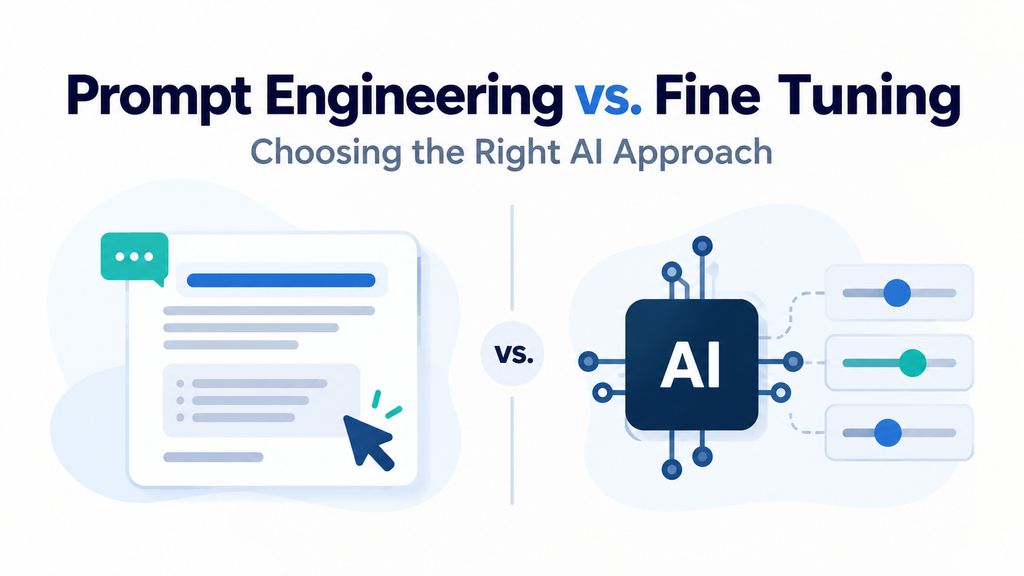
Two common approaches to customization are prompt engineering and fine-tuning. Prompt engineering improves results through clear instructions and examples, while fine-tuning adapts a model using specialized training data.
Choosing the right approach depends on your performance requirements, budget, and business goals. Combining these methods with Retrieval Augmented Generation (RAG) can further improve results when AI systems need access to current, reliable information.
This guide explains how prompt engineering and fine-tuning work, compares their advantages and limitations, and explores how businesses can select the right strategy for their AI applications.
What Is Prompt Engineering?
Prompt Engineering is the process of designing and refining instructions given to an AI model to influence the quality, structure, and relevance of its responses.
A prompt can contain a question, task instructions, background information, examples, formatting requirements, and rules the model should follow.
The objective is to communicate the task clearly enough that the model produces an output that meets the intended requirements without modifying its underlying parameters.
For example, a general AI assistant might generate a lengthy response when asked to explain a technical concept. A carefully designed prompt can instruct it to use simple language, provide practical examples, organize the explanation into sections, and finish with frequently asked questions.
The underlying model remains unchanged. Only the instructions and contextual information supplied to it are different.
How Prompt Engineering Works
A typical Prompt Engineering workflow involves four steps.
Define the task: Identify the desired outcome, such as answering customer questions, generating product descriptions, or summarizing documents.
Write clear instructions: Specify the model’s role, objective, audience, limitations, and expected output format.
Provide relevant examples: Include sample inputs and outputs when the model needs to follow a particular pattern or writing style.
Test and refine: Evaluate the responses, identify errors, and revise the prompt until the results meet the required quality standards.
This process can be repeated without retraining the model, making Prompt Engineering particularly useful during early development and experimentation.
Important Prompt Engineering Techniques
Zero Shot Prompting
Zero Shot Prompting asks a model to complete a task without providing examples in the prompt.
For example, a business might ask an AI model to classify customer feedback as positive, negative, or neutral. The model relies on its existing capabilities and the instructions provided.
This technique is simple and often sufficient for straightforward tasks.
Few Shot Prompting
Few Shot Prompting includes a small number of examples that demonstrate the expected response pattern.
For instance, a company can provide examples of customer inquiries alongside the appropriate support responses. The model can use these examples as guidance when handling similar requests.
This approach is useful when the desired format or classification rules are difficult to communicate through instructions alone.
Structured Prompting
Structured prompts separate instructions, background information, input data, and output requirements into clearly defined sections.
This makes complex tasks easier to manage and can improve consistency across repeated requests.
For example, an AI content generation system might receive separate instructions for the target keyword, intended audience, article structure, tone, and formatting requirements.
Reasoning Oriented Prompting
Reasoning oriented prompts encourage a model to approach complex tasks systematically. Depending on the model and task, this can involve asking for intermediate checks, explicit assumptions, calculations, or a structured explanation.
However, detailed instructions do not guarantee correct reasoning. Results should still be evaluated, especially in technical, financial, and other high impact applications.
Advantages of Prompt Engineering
Prompt Engineering offers several practical benefits.
- Lower initial investment: It generally requires no model training infrastructure or dedicated training dataset.
- Fast experimentation: Developers can modify instructions and test new approaches quickly.
- Easy maintenance: Updating a prompt is usually simpler than running another training process.
- Flexible behavior: The same model can handle different tasks through different prompts.
- Quick prototyping: Teams can validate an AI product idea before investing in more complex customization.
Limitations of Prompt Engineering
Prompt Engineering also has limitations.
Complex prompts can become difficult to maintain, especially when they contain many instructions, examples, and exceptions. Longer prompts can increase token usage and latency, depending on the model and deployment environment.
Prompting also depends on the model’s existing capabilities. Instructions cannot reliably give a model skills it does not possess, and providing more context does not guarantee that every detail will be interpreted correctly.
For applications requiring highly consistent behavior across large volumes of requests, prompt improvements alone may eventually reach a practical limit.
What Is Fine Tuning?
Fine Tuning is a machine learning technique that adapts a pretrained model by training it further on a carefully prepared dataset.
Unlike Prompt Engineering, which changes the instructions supplied during a request, Fine Tuning modifies some or all of the model’s trainable parameters.
The purpose is to improve performance on a particular task, encourage a specific response style, or help the model follow specialized patterns more consistently.
For example, a company providing technical support might fine tune a suitable language model using reviewed examples of customer questions and high quality support responses. After training, the model may become better at following the company’s preferred response structure and terminology.
However, Fine Tuning does not automatically create a reliable database of all company information. The model may learn patterns from its training examples without consistently recalling every individual fact.
For information that must remain current and verifiable, an external retrieval system is often a better solution.
How Fine Tuning Works
A typical Fine Tuning workflow involves the following stages.
Prepare the dataset: Collect examples that represent the desired behavior, including appropriate inputs and outputs.
Clean and validate the data: Remove duplicates, correct errors, standardize formats, and ensure that the data is suitable for the intended task.
Select a base model: Choose a pretrained model that has the capabilities, licensing terms, and deployment characteristics required by the application.
Configure training: Select the training method, parameters, validation approach, and computational resources.
Train the model: Run the training process to adjust the relevant parameters or trainable components.
Evaluate the results: Compare the adapted model against the original model using representative test cases.
Deploy and monitor: Integrate the model into the application, monitor its performance, and retrain or revise it when necessary.
The quality of the dataset is critical. Poorly selected or inconsistent examples can reduce performance rather than improve it.
Understanding LoRA and Parameter Efficient Fine Tuning
Traditional Fine Tuning can require substantial computing resources, particularly when updating every parameter in a large model.
Parameter Efficient Fine Tuning (PEFT) provides alternatives that reduce the number of parameters that must be trained.
One widely used technique is LoRA, or Low Rank Adaptation.
LoRA introduces small trainable components into selected parts of a model while leaving the original weights largely unchanged. These components learn adjustments that can improve the model’s performance on a target task.
This can reduce training memory requirements, computational costs, and the storage needed for task specific adaptations.
LoRA does not eliminate every cost associated with Fine Tuning. The required resources still depend on the model, dataset, sequence lengths, training configuration, and available hardware.
Advantages of Fine Tuning
Fine Tuning can provide several benefits.
- More consistent outputs: The model can learn recurring response patterns and preferred formats.
- Specialized task performance: Training examples can help the model adapt to particular classification, extraction, or generation tasks.
- Reduced prompt complexity: Some behavioral instructions and examples may no longer need to be repeated in every request.
- Domain specific terminology: The model can become more familiar with specialized language represented in the training data.
- Potential operating efficiencies: A smaller adapted model may perform a narrow task effectively without relying on a larger, more expensive model.
Limitations of Fine Tuning
Fine Tuning introduces additional complexity.
Preparing a high quality dataset takes time, and training requires suitable infrastructure or a compatible managed service. The adapted model must also be evaluated carefully to ensure that improvements on the target task do not cause unacceptable regressions elsewhere.
Fine Tuning may not be the right solution when the primary requirement is access to frequently changing information. Updating model weights whenever a product catalog, price list, or policy changes can be inefficient.
It also does not guarantee factual accuracy, eliminate hallucinations, or provide a security boundary for confidential information.
Prompt Engineering vs. Fine Tuning: Key Differences
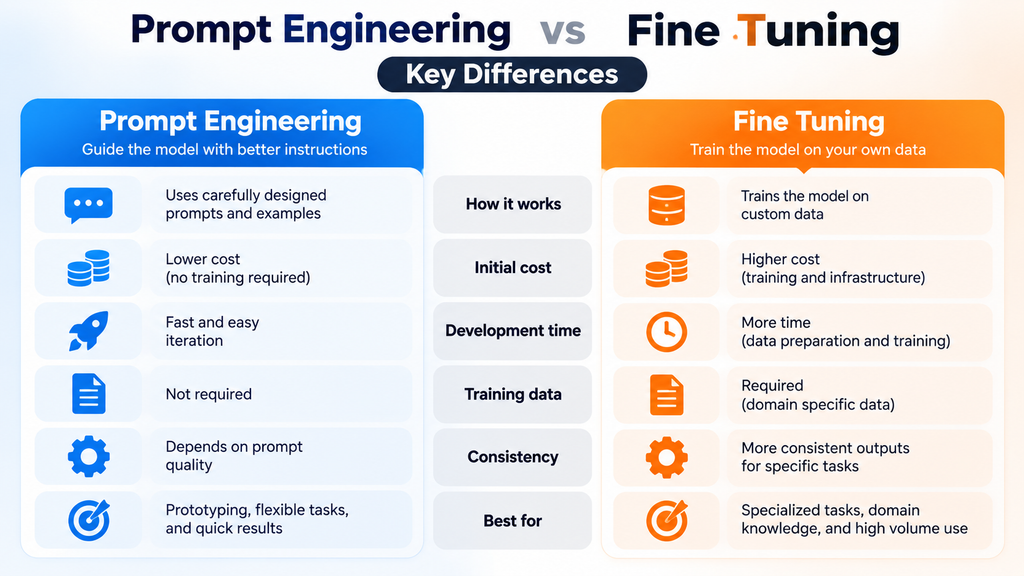
The main difference is where the customization happens. Prompt Engineering modifies the information and instructions supplied to a model at inference time. Fine Tuning modifies trainable model parameters through additional training.
| Comparison factor | Prompt Engineering | Fine Tuning |
| How it works | Refines instructions and contextual input | Trains a model on curated examples |
| Initial cost | Usually lower | Usually higher |
| Development speed | Fast iteration | Requires data preparation and training |
| Training dataset | Not required | Required |
| Behavioral consistency | Depends on instructions and model behavior | Can improve consistency on target tasks |
| Dynamic information | Can use updated context | Does not automatically reflect new information |
| Technical complexity | Low to moderate | Moderate to high |
| Maintenance | Revise prompts and test changes | Evaluate model behavior and manage training updates |
| Best suited for | Flexible tasks and rapid experimentation | Repeated specialized tasks and learned response patterns |
These comparisons are general rather than absolute. Actual performance depends on the model, task, implementation, and quality of the evaluation process.
Performance, Latency, and Scalability
Selecting an AI customization strategy requires more than comparing response accuracy. Businesses should also consider latency, throughput, infrastructure requirements, and the volume of information supplied with each request.
Response Time and Context Window Limitations
Prompt Engineering can increase response latency when prompts contain extensive instructions, examples, or retrieved documents. Larger inputs also consume more of the model’s available context window.
If a prompt exceeds the model’s context limit, the request may need to be shortened or divided into smaller tasks. Even when the entire input fits, the model may not use every detail equally effectively.
Fine Tuning can reduce the need to repeat behavioral examples and some task specific instructions. This may reduce input token usage and improve overall efficiency.
However, Fine Tuning does not automatically make inference faster. Actual latency depends on the model architecture, serving infrastructure, output length, batching, and other implementation details.
Accuracy and Output Consistency
Prompt Engineering is effective when the model already understands the task and needs clearer instructions or additional context.
Fine Tuning becomes worth considering when a model repeatedly struggles with a specialized output pattern despite systematic prompt improvements.
For example, a data extraction system might need to return information in a strict JSON schema. Prompting may be sufficient for many models, while Fine Tuning may help when the task involves a large number of recurring patterns and demanding consistency requirements.
In either case, the system should be tested against representative examples, including unusual inputs and edge cases.
Scaling an AI Application
At low request volumes, Prompt Engineering is often the simplest option because it avoids the overhead of a separate training pipeline.
At high request volumes, repeatedly sending long prompts can increase costs and consume more processing capacity. Fine Tuning may reduce the amount of input context required for a specialized task.
Nevertheless, a fine tuned model may require additional training infrastructure, model hosting, monitoring, and version management. A smaller model can sometimes provide a more economical solution, but this must be demonstrated through testing rather than assumed.
Cost Analysis: Which Approach Offers Better ROI?
Return on investment depends on the full cost of building and operating the system, not just the price of an API request or a training run.
Prompt Engineering Costs
The main costs associated with Prompt Engineering typically include:
- Input and output token charges when using a paid model API.
- Developer time spent designing and testing prompts.
- Additional processing for large contextual inputs.
- Evaluation, monitoring, and ongoing prompt maintenance.
A well designed prompt can be inexpensive to implement. However, lengthy prompts repeated across thousands or millions of requests can become a significant recurring expense.
Fine Tuning Costs
Fine Tuning introduces a different cost structure.
- Dataset collection, cleaning, labeling, and validation.
- Training compute or managed training service charges.
- Experimentation and model evaluation.
- Deployment and model hosting.
- Monitoring, version control, and future training updates.
Fine Tuning may reduce recurring inference costs in some implementations, particularly when a smaller adapted model replaces a more expensive general purpose model or when long prompts can be shortened.
That outcome is not guaranteed. A fine tuned model can cost more to train and operate if its hosting requirements are substantial or its performance does not justify the additional expense.
Calculating the Break Even Point
A practical cost comparison should account for both initial investment and recurring expenses.
Use the following framework:
Total Prompting Cost
Initial development cost + cumulative inference cost + evaluation and maintenance cost.
Total Fine Tuning Cost
Dataset preparation cost + training cost + deployment cost + cumulative inference cost + evaluation and maintenance cost.
Fine Tuning becomes financially attractive when the savings and measurable business benefits over the evaluation period exceed its additional upfront and ongoing costs.
For example, a company processing a high volume of repetitive support requests could compare the cost of a general model using long prompts with a smaller adapted model using shorter prompts. The decision should be based on measured quality, response time, and total operating cost.
For frequently changing information, a retrieval based approach may avoid repeated training expenses and make updates easier to manage.
Prompt Engineering, Fine Tuning, and RAG: Understanding the Difference
Retrieval Augmented Generation (RAG) is another important technique for improving AI applications. Although it is often discussed alongside Prompt Engineering and Fine Tuning, it solves a different problem.
RAG connects a language model to an external information source. When a user asks a question, the system retrieves relevant documents or records and provides that information to the model as contextual input.
A typical RAG system may use a search engine or vector database to identify relevant content from company documents, product catalogs, policies, or other approved sources.
For example, an online store could use RAG to answer questions about current product availability, pricing, and return policies using its latest data.
Why RAG Is Useful
RAG offers several advantages when an application depends on external information.
Access to updated information: The system can retrieve newly added or revised documents without retraining the model, provided the retrieval index or connected data source has been updated.
Better factual grounding: Responses can be generated using relevant source material rather than relying exclusively on the model’s pretrained knowledge.
Source traceability: The application can display references to retrieved documents, making it easier to verify answers.
Flexible knowledge management: Businesses can update or remove documents independently of model training.
RAG still has limitations. Retrieval can miss relevant documents, return outdated records, or supply conflicting information. The model may also misinterpret the retrieved material. Reliable systems therefore need retrieval evaluation, access controls, and answer verification.
RAG vs. Fine Tuning
RAG is generally preferable when the main challenge is providing access to current, detailed, or frequently changing facts.
Fine Tuning is generally more relevant when the main challenge is teaching a model to perform a task in a particular way, follow recurring output patterns, or adopt a specialized response style.
These approaches can also be combined. A fine tuned model can use retrieved documents to answer questions in a consistent format while grounding its responses in current information.
When Should You Choose Prompt Engineering?
Prompt Engineering is a strong starting point when a model already has the capabilities needed for the task.
Consider it for the following use cases.
Content generation: Producing blog outlines, product descriptions, social media content, and marketing drafts with specific formatting requirements.
Customer support prototypes: Testing whether an AI assistant can answer common questions using clear instructions and a limited set of examples.
Data transformation: Converting text into structured formats, summarizing reports, and categorizing feedback.
Software development assistance: Guiding a model to explain code, generate tests, or follow a particular coding convention.
Early product validation: Testing an AI feature before investing in dataset preparation, model training, or complex infrastructure.
The key advantage is flexibility. Teams can test ideas quickly and learn whether the existing model is capable of meeting their requirements.
When Should You Choose Fine Tuning?
Fine Tuning is worth evaluating when repeated testing shows that prompting alone does not deliver the required task performance or consistency.
Potential use cases include:
Specialized classification: Categorizing technical support tickets, financial documents, or industry specific records using recurring patterns.
Consistent output generation: Producing responses that follow a specialized structure or established writing style.
Domain specific language: Handling terminology, abbreviations, and patterns that are well represented in a curated training dataset.
Task specific smaller models: Adapting a suitable smaller model to handle a narrow task efficiently, potentially reducing dependence on a larger general purpose model.
Repeated high volume workflows: Improving a frequently used process where measurable gains in quality, latency, or cost justify the training investment.
Fine Tuning is not a substitute for expert validation in high impact areas such as medicine, law, and finance. These applications require appropriate safeguards, reliable source information, and qualified human oversight.
The Hybrid Approach: Combining Prompt Engineering, RAG, and Fine Tuning
Many production AI systems benefit from combining several techniques instead of treating them as competing alternatives.
Each component has a distinct role.
Prompt Engineering defines the task, constraints, and expected response format.
RAG supplies relevant external information that may change over time.
Fine Tuning adapts the model to recurring task patterns and specialized behavior when necessary.
Consider a company building an internal AI assistant for its employees. The assistant must follow a consistent response format, answer questions about company policies, and use the latest approved documentation.
A practical architecture could use Prompt Engineering to define the assistant’s behavior, RAG to retrieve current policy documents, and Fine Tuning to improve specialized response patterns if evaluation demonstrates a meaningful benefit.
This approach can be more effective than expecting a single technique to solve every problem.
However, adding components also increases engineering complexity. A hybrid architecture should be adopted when the measured benefits justify its additional development, testing, and maintenance requirements.
Best Practices for Implementing an AI Customization Strategy
A disciplined implementation process helps organizations avoid unnecessary complexity and spending.
Start With a Clearly Defined Problem
Identify what the existing model is doing incorrectly. Is it missing information, ignoring instructions, producing inconsistent formats, or struggling with a specialized task?
Different failure types require different solutions.
Establish a Baseline
Before changing the system, evaluate the original model using representative examples.
Measure relevant metrics such as task accuracy, completion rate, response latency, formatting compliance, and cost per successful result.
A baseline makes it possible to determine whether customization actually improves performance.
Improve the Prompt First
Begin with clear instructions, suitable examples, and explicit output requirements.
Use repeatable tests to determine whether the problem can be solved without model training.
Add RAG When Information Is the Problem
If the model needs current company information, product data, or detailed documentation, evaluate a retrieval system before attempting to encode that information into model parameters.
Ensure that the retrieved information is accurate, relevant, and authorized for the user requesting it.
Fine Tune When Testing Justifies It
If the model continues to underperform on a recurring task, prepare a curated dataset and compare a fine tuned candidate against the original model.
Use separate training, validation, and test data to reduce the risk of overfitting and misleading evaluation results.
Monitor the Deployed System
Model behavior, source data, and business requirements can change over time.
Track performance after deployment, test important changes before release, and maintain clear versions of prompts, datasets, retrieval indexes, and models.
The Future of AI Customization
AI development is moving toward systems that combine language models with retrieval, tools, structured workflows, and agent based orchestration.
Instead of relying exclusively on a single model response, these systems can retrieve information, call approved tools, validate outputs, and complete multistep tasks.
This does not mean that AI agents will always select the correct strategy automatically. Their decisions still depend on system design, permissions, evaluation, and the reliability of the underlying models and tools.
As these technologies mature, businesses will increasingly focus on choosing the simplest architecture that meets their performance, cost, and reliability requirements.
Prompt Engineering, Fine Tuning, and RAG will continue to serve complementary purposes within that broader ecosystem.
Frequently Asked Questions
Is Prompt Engineering always cheaper than Fine Tuning?
No. Prompt Engineering usually has lower initial costs because it does not require model training. However, long prompts and high request volumes can increase recurring expenses. Fine Tuning may become economical when it reduces inference costs or produces measurable improvements at scale.
How much data is needed for Fine Tuning?
There is no universal minimum dataset size. Requirements depend on the model, task complexity, dataset quality, and the size of the expected improvement. A carefully curated collection of examples may be useful for a narrow task, but more complex tasks can require substantially more data and experimentation
Can I Fine Tune an AI model using PDF documents?
PDFs can be part of the data preparation process, but they usually need to be extracted, cleaned, and transformed into an appropriate training format. If the objective is to answer questions using the documents’ contents, RAG is often the better starting point.
Is RAG better than Fine Tuning for current information?
RAG is generally better suited to frequently changing information because it can retrieve updated content without retraining the model. Fine Tuning is more suitable for adapting task behavior and response patterns. The two techniques can work together.
Can Prompt Engineering replace Fine Tuning?
Sometimes. A carefully designed prompt can produce excellent results when the underlying model already has the required capabilities. Fine Tuning may provide additional benefits when a recurring task remains inconsistent despite systematic prompt improvements.
Which approach is best for beginners?
Prompt Engineering is generally easier to learn and experiment with because it does not require a training pipeline. Fine Tuning typically requires additional knowledge of datasets, model evaluation, training methods, and deployment.
Can I use LoRA instead of full Fine Tuning?
Yes, when the selected model and training setup support it. LoRA can reduce the number of trainable parameters and lower resource requirements. Its effectiveness depends on the task, model, and training configuration.
Should every business use a hybrid AI architecture?
No. A hybrid system is useful when its components solve distinct problems that matter to the business. For simple applications, a well designed prompt and an existing model may be sufficient. Additional components should be introduced only when they provide measurable benefits.
Does Fine Tuning eliminate AI hallucinations?
No. Fine Tuning can improve performance on particular tasks, but it does not guarantee factual accuracy. Applications that require reliable information should use suitable source grounding, testing, validation, and human oversight.
Does Fine Tuning improve security?
Fine Tuning is not automatically more secure than Prompt Engineering. Security depends on the complete system, including data handling, access controls, model hosting, logging, and deployment practices. Training sensitive information into model parameters can introduce additional risks and should be evaluated carefully.
What is the fastest way to build an AI proof of concept?
Prompt Engineering is usually the fastest starting point because it avoids the time required to prepare a training dataset and run a training process. If the application needs external information, a simple RAG prototype may also be appropriate.
Conclusion
Prompt Engineering and Fine Tuning are two different ways to customize AI systems. Neither is universally superior, and the right choice depends on the task, available data, quality requirements, operating costs, and deployment constraints.
Prompt Engineering is usually the best place to start because it enables rapid experimentation without model training. RAG is particularly useful when the application needs current, detailed, or verifiable external information. Fine Tuning becomes worth considering when a model needs to learn recurring task patterns or achieve more consistent specialized behavior.
For businesses planning an AI deployment, the most practical strategy is to begin with a clear problem definition and a measurable baseline. Improve the prompt, introduce retrieval when information access is the main limitation, and evaluate Fine Tuning when testing shows that additional adaptation could justify its cost.
The goal is not to use the most complicated AI architecture. It is to build the simplest reliable system that delivers measurable business value.