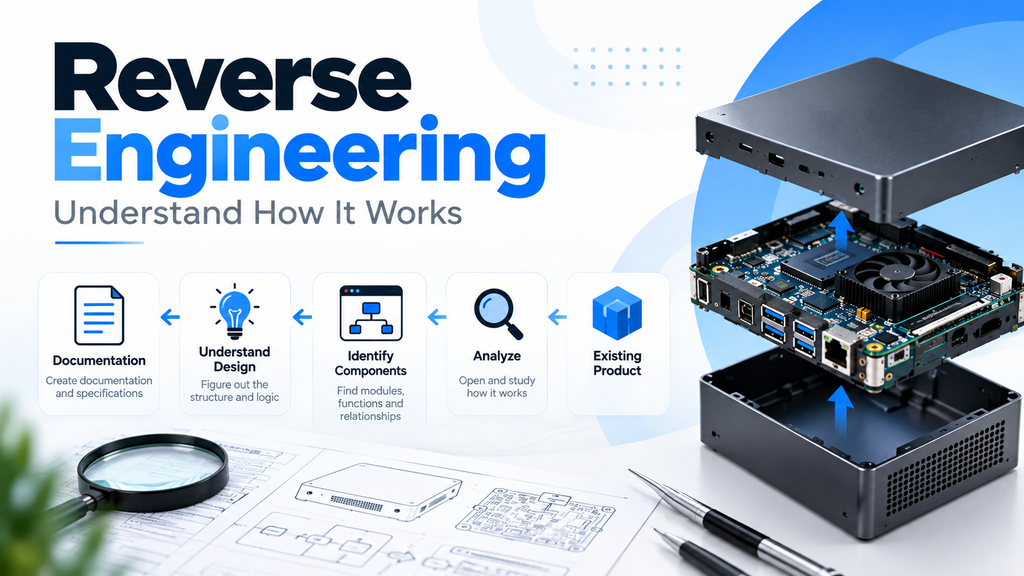
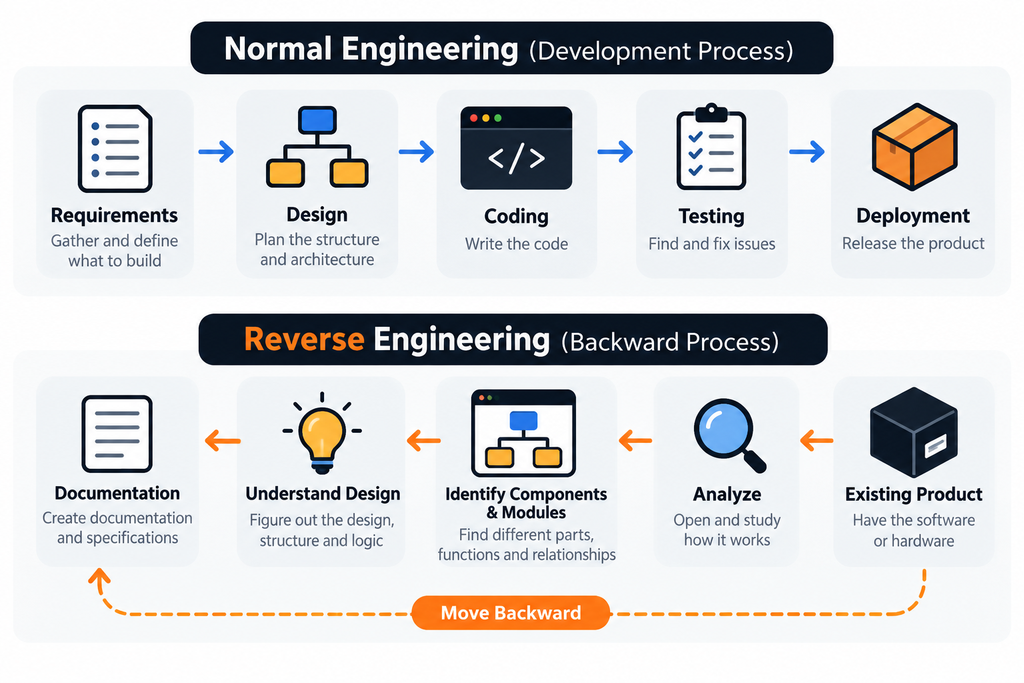
Reverse engineering is the process of studying an existing product, system, software, hardware, or encoded data to understand how it works. Instead of creating something from requirements and moving toward the final product, reverse engineering works in the opposite direction: we start with the finished product and move backward to understand its design, structure, functionality, and implementation.
In simple words, reverse engineering means taking an existing system apart physically or logically to understand how it was made and how it works.
What Is Reverse Engineering?
In normal software development, the process usually follows this direction:
For example, suppose you have an old software application but its documentation is missing. By examining its source code, modules, database, interfaces, and functionality, you can understand how the application works and create documentation for it.
This is why reverse engineering is also called backward engineering.
Why Is Reverse Engineering Used?
One of the major purposes of reverse engineering is system improvement.
Software is regularly updated. Suppose an operating system has an older version, such as version 8.0, and a company wants to develop version 9.0. Engineers can study the previous version to understand its functionality, identify limitations and problems, and then develop an improved version.
The goal is not simply to copy the old system. Instead, engineers can learn from the existing implementation and create a better system.
Reverse Engineering and Legacy Systems
Another important application of reverse engineering is working with legacy systems.
Many organizations still depend on old software and hardware that were developed decades ago. Some of these systems may have incomplete or outdated documentation because their developers did not properly document every stage of development.
Reverse engineering can help engineers understand these systems.
For hardware, engineers may examine the physical components, architecture, circuits, and functionality to understand how the system operates.
The information obtained through this process can then be used to create new documentation or improve the existing system.
Reverse Engineering of Software
Software reverse engineering involves analyzing an existing software product to understand its internal structure and behavior.
If source code is available, engineers can study and reorganize it to make it easier to understand. If source code is unavailable, specialized tools can sometimes be used to analyze compiled programs and determine how they work.
This can be particularly useful when maintaining old software where the original developers are no longer available.
Reverse Engineering and Security
Reverse engineering also has an important role in cybersecurity.
Security researchers can analyze software to discover vulnerabilities, understand malicious programs, and determine how an attack works.
For example, malware analysts may reverse engineer a suspicious program to understand:
What the program does
Which files it accesses
How it communicates
What system components it modifies
What vulnerabilities it attempts to exploit
Security professionals can then use this knowledge to develop defenses, detections, and security patches.
Therefore, reverse engineering is not inherently malicious. It can be used for legitimate security research and defensive purposes.
Reverse Engineering and Cryptanalysis
Reverse engineering is also related conceptually to cryptanalysis.
In cryptanalysis, a researcher may have encrypted or encoded information and attempt to determine how the encryption or encoding works.
For example, during World War II, Alan Turing and other researchers worked on analyzing the German Enigma system. They studied encrypted communications and the mechanisms behind the encryption to help determine how messages could be deciphered.
The basic idea is similar: instead of starting with the design and producing the output, researchers start with the output and work backward to understand the process that produced it.
The Phoenix Technologies BIOS Example
A famous historical example often discussed in relation to reverse engineering involves BIOS compatibility.
IBM had developed its own BIOS for its PCs. Other companies wanted to create compatible systems without simply copying IBM’s protected code.
A technique known as clean-room reverse engineering could be used for this type of situation.
One team studies the behavior and functionality of the original system and produces documentation describing what the system needs to do. A separate development team, which does not have access to the original source code, then implements a compatible system based on that documentation.
This separation is important because simply copying source code can create intellectual-property and copyright problems.
Reverse Engineering vs. Copying
It is important to understand that reverse engineering and copying are not the same thing.
Reverse engineering means studying an existing system to understand its architecture, functionality, behavior, or implementation.
Copying someone else’s source code, proprietary design, or protected material and presenting it as your own can create serious legal and ethical problems.
The legality of reverse engineering depends on factors such as:
Applicable copyright law
Software licenses
Patents
Contracts
Terms of service
The purpose of the analysis
The jurisdiction involved
Therefore, reverse engineering should be performed responsibly and within applicable laws and licenses.
Advantages of Reverse Engineering
Reverse engineering provides several important benefits.
System improvement: Engineers can identify weaknesses and limitations in an existing system and improve future versions.
Legacy system maintenance: Old systems can be understood even when their original documentation is missing.
Security analysis: Researchers can investigate malware and discover vulnerabilities.
Documentation: Existing undocumented systems can be converted into understandable technical documentation.
Compatibility: Engineers can understand how an existing system behaves and develop compatible systems where legally permitted.
Learning: Students and developers can study existing systems to understand real-world software architecture and implementation techniques.
FAQs
What is reverse engineering in simple words?
Reverse engineering means studying an existing product or system to understand how it was made and how it works.
What is the main purpose of reverse engineering?
The main purposes include understanding existing systems, improving software, documenting legacy systems, finding security vulnerabilities, and maintaining older technology.
Is reverse engineering the same as copying?
No. Reverse engineering involves analysis and understanding, while unauthorized copying involves reproducing protected material. The legal implications depend on the specific situation.
What is software reverse engineering?
Software reverse engineering is the process of analyzing an existing software application to understand its code, structure, modules, algorithms, behavior, and functionality.
What are legacy systems?
Legacy systems are older software or hardware systems that may still be in use even though their technology or documentation is outdated.
Is cryptanalysis a form of reverse engineering?
Cryptanalysis is a distinct field, but it shares a similar work-backward concept: analyzing encrypted or encoded information to understand how it was produced or how it can be deciphered.
What is clean-room reverse engineering?
Clean-room reverse engineering is an approach in which one team analyzes and documents a system while a separate team uses that documentation to develop an implementation, helping avoid direct use of the original protected source code.
Is reverse engineering legal?
It depends on the specific circumstances, including local law, copyright, patents, software licenses, contracts, and the purpose of the analysis. Permission and licensing requirements should always be checked before analyzing proprietary systems.
Conclusion
Reverse engineering is essentially the process of working backward from an existing product or system to understand how it works.
Reverse engineering follows the opposite direction:
Existing System → Implementation → Design → Documentation/Requirements
It is widely useful in software development, cybersecurity, legacy-system modernization, hardware analysis, system maintenance, and cryptanalysis.
However, reverse engineering should be distinguished from unauthorized copying. Its legitimate purpose is to understand, analyze, maintain, improve, secure, or document existing systems while respecting applicable laws and intellectual-property rights.