
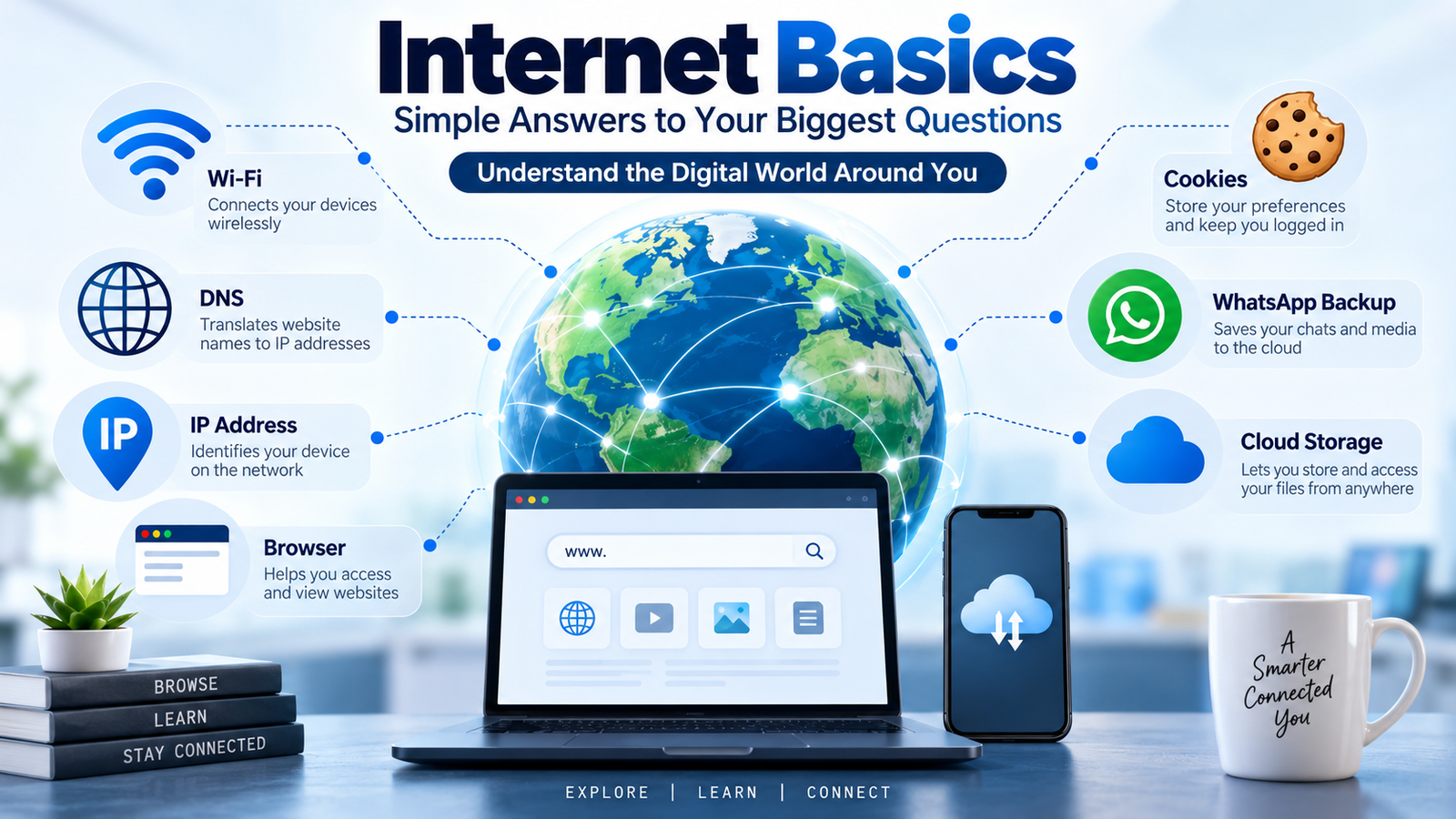
The internet is now part of almost every aspect of daily life. We use it to browse websites, send WhatsApp messages, watch videos, store photos, make payments, and access online services. But many people still wonder what actually happens behind the scenes.
This guide explains the basic concepts of the internet in simple words and answers the most commonly asked questions about how the internet works, IP addresses, DNS, Wi-Fi, cookies, browsers, WhatsApp backups, and cloud storage.
How Does the Internet Work?
The Internet is a huge network that connects billions of computers, smartphones, servers, and other devices around the world. When you open a website, your device communicates with a server through several networks before the requested information reaches your screen.
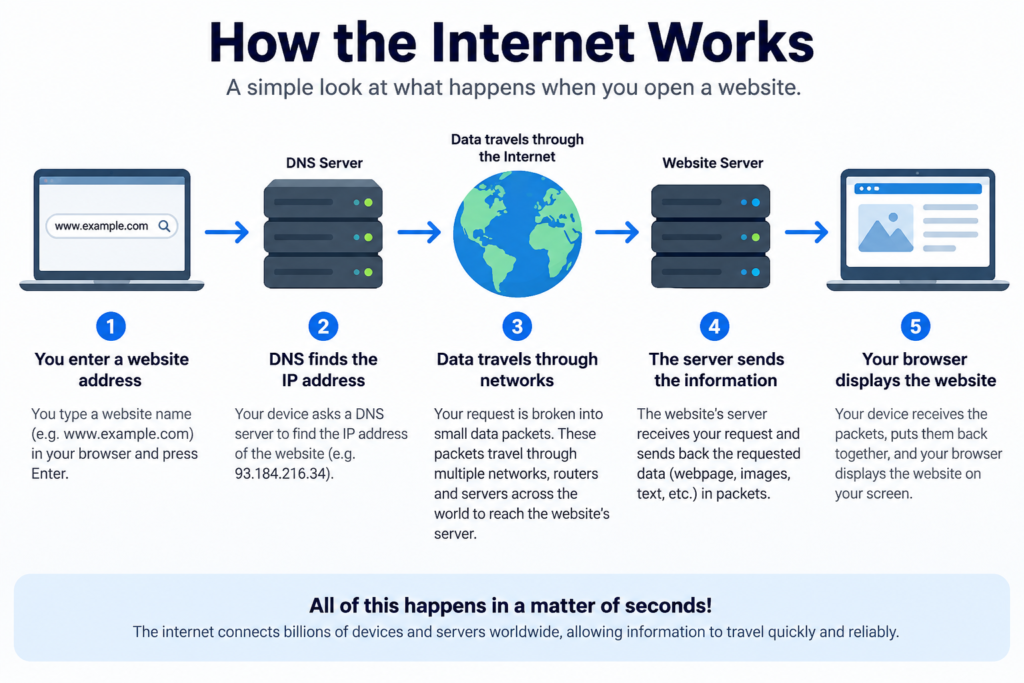
For example, when you type a website address into your browser, the browser finds the website’s server, sends a request, receives the required data, and displays the webpage.
What happens when you open a website?
Your browser sends a request to the website’s server. DNS helps find the server’s IP address, and your request travels through your internet connection to that server. The server then sends information back to your device.
Does the internet work without Wi-Fi?
Yes. Wi-Fi is only one way to connect to the internet. You can also access the internet using mobile data, Ethernet, fiber connections, DSL, or other network technologies.
Is Wi-Fi the same as the internet?
No. Wi-Fi is a technology that connects your device wirelessly to a local network. The internet is the worldwide network that your local network may connect to.
Why does the internet sometimes become slow?
Internet speed can be affected by network congestion, weak Wi-Fi signals, too many connected devices, router problems, ISP issues, server load, or a slow internet plan.
What is an ISP?
An ISP (Internet Service Provider) is a company that provides internet access. Your ISP connects your home or mobile device to the wider internet.
How does data travel across the internet?
Data is divided into small units called packets. These packets travel through networks and routers toward their destination. The receiving system puts the information back together.
What is a server?
A server is a computer or system that provides data or services to other computers. Websites, applications, videos, and online files can all be hosted on servers.
What Is an IP Address?
An IP address is a numerical address used to identify a device or network on an IP-based network. It helps network traffic know where information should be delivered.
There are two major versions: IPv4 and IPv6.
An IPv4 address might look like:
192.168.1.10
An IPv6 address is much longer because IPv6 provides a vastly larger number of addresses.
What is a public IP address?
A public IP address is an address associated with your connection to the internet. It can be used by internet services to communicate with your network.
What is a private IP address?
A private IP address is used inside a local network, such as your home Wi-Fi network. Devices connected to the same router can have private IP addresses such as 192.168.1.5.
What is the difference between public and private IP addresses?
A public IP is used for communication with the wider internet, while a private IP is used within a local network.
Can two devices have the same IP address?
Two devices generally cannot use the same public IP address at the same time on the same internet context. However, many devices in different private networks can use the same private IP address.
Does an IP address reveal your exact location?
Usually, an IP address can provide an approximate geographic location, such as a country or general region. It normally does not reveal your exact home address by itself.
Can an IP address change?
Yes. Many internet connections use dynamic IP addresses, which can change over time. Some customers can also have a static IP address.
What is localhost?
Localhost refers to the device you are currently using. The commonly used IPv4 localhost address is 127.0.0.1.
What is IPv4?
IPv4 is the older and still widely used Internet Protocol addressing system. It uses 32-bit addresses.
What is IPv6?
IPv6 is the newer Internet Protocol version. It uses 128-bit addresses, providing an extremely large address space.
What Is DNS?
DNS (Domain Name System) works like a directory for the internet. Humans prefer names such as example.com, while computers communicate using IP addresses.
DNS helps translate a domain name into an IP address so your device can connect to the correct server.
Why is DNS important?
Without DNS, users would have to remember numerical IP addresses for websites instead of convenient domain names.
What happens when you type a website name?
Your device or browser checks available DNS information to find the IP address associated with the domain. Once the address is found, the browser can communicate with the appropriate server.
What is a DNS server?
A DNS server responds to requests for domain information. Your ISP may provide DNS servers automatically, or you can use another DNS service.
Can changing DNS make the internet faster?
Sometimes changing DNS can improve DNS lookup speed or reliability, but it does not automatically increase the bandwidth of your internet connection.
Can DNS be used for security?
Yes. Some DNS services can block known malicious or unwanted domains, although DNS alone is not a complete security solution.
What is a DNS cache?
A DNS cache temporarily stores recently resolved domain information. This can reduce the need to repeatedly perform DNS lookups.
Why does a website sometimes not open after changing DNS?
DNS changes can take time to propagate, and your device, router, ISP, or DNS resolver may still have older cached information.
What Is Wi-Fi?
Wi-Fi is a wireless networking technology that allows devices such as smartphones, laptops, tablets, smart TVs, and printers to communicate with a local network without using a physical Ethernet cable.
A Wi-Fi router or access point provides the wireless connection. The router can then connect that local network to the internet.
Is Wi-Fi free?
Wi-Fi itself is a technology, not necessarily a free service. A public Wi-Fi network may be free, while home Wi-Fi usually requires an internet subscription.
Why is my Wi-Fi slow?
Common reasons include distance from the router, walls and obstacles, interference, too many connected devices, outdated equipment, or internet service problems.
Why is Wi-Fi connected but there is no internet?
Your device may successfully connect to the router, while the router itself may have lost its connection to the internet.
Does restarting the router help?
Restarting the router can resolve temporary connection, software, or network issues. It is one of the simplest troubleshooting steps.
What is a Wi-Fi password?
A Wi-Fi password protects your wireless network from unauthorized access. A strong password helps prevent unknown devices from connecting.
Is 5 GHz Wi-Fi faster than 2.4 GHz?
5 GHz Wi-Fi can generally provide higher speeds and less congestion over shorter distances, while 2.4 GHz usually provides better range and can travel through obstacles more effectively.
What is 6 GHz Wi-Fi?
The 6 GHz band is used by newer Wi-Fi technologies and can provide additional wireless spectrum, helping compatible devices achieve high performance with less congestion.
What is a Wi-Fi router?
A router directs network traffic between your local network and other networks, including the internet. Modern home routers often also include Wi-Fi access-point functionality.
What Are Cookies?
Cookies are small pieces of information that websites store in your browser. They can help websites remember information about your visit.
For example, cookies can help keep you logged in, remember preferences, maintain shopping carts, or measure website usage.
Are cookies dangerous?
Cookies are not automatically dangerous. However, tracking cookies can be used to collect information about browsing activity, which raises privacy concerns.
Do cookies contain passwords?
Normally, websites should not store your actual password in a cookie. Instead, a cookie may contain a session identifier that helps a website recognize your logged-in session.
What happens if I delete cookies?
Deleting cookies can sign you out of websites, remove saved preferences, and reset certain website settings.
Should I accept all cookies?
Not necessarily. Many websites provide cookie choices. You can often reject or limit optional cookies, especially those used for advertising or tracking.
What are third-party cookies?
Third-party cookies are cookies associated with a domain different from the website you are directly visiting. They have commonly been used for advertising and cross-site tracking.
Do cookies slow down the internet?
Cookies generally have a very small impact on browsing speed. Having many cookies can create browser storage and privacy concerns, but they are not usually the main reason for slow internet.
Are cookies the same as cache?
No. Cookies store information that websites can use to recognize or remember things about you. A cache stores copies of resources such as images and scripts to help webpages load faster.
What Is a Browser?
A web browser is software used to access and interact with websites. Popular browsers include Google Chrome, Mozilla Firefox, Microsoft Edge, Safari, and Opera.
When you enter a website address, the browser communicates with servers, receives webpage resources, and displays the resulting page.
What does a browser do?
A browser can load webpages, display images and videos, run web applications, store cookies, manage downloads, and execute web code.
Which browser is best?
There is no single best browser for everyone. Chrome, Firefox, Edge, Safari, and other modern browsers offer different combinations of performance, privacy, compatibility, and features.
What is browser cache?
A browser cache stores copies of certain website resources on your device. When you revisit a website, the browser may reuse these resources instead of downloading everything again.
Why should I clear browser cache?
Clearing the cache can help when a website is showing outdated files, displaying errors, or behaving unexpectedly.
What is Incognito or Private Browsing?
Private browsing prevents the browser from saving certain local browsing information, such as browsing history, after the private session ends. It does not make you completely anonymous online.
Does Incognito hide my IP address?
No. Private browsing does not normally hide your IP address from websites, your ISP, or network administrators.
Why does my browser keep crashing?
Browser crashes can be caused by outdated software, problematic extensions, corrupted data, insufficient memory, or compatibility issues.
Should I keep my browser updated?
Yes. Browser updates often include security fixes, performance improvements, and compatibility updates.
How Does WhatsApp Backup Work?
WhatsApp Backup allows users to save copies of their WhatsApp chat history and related data so it can potentially be restored when setting up WhatsApp on a new or reset device.
On Android, WhatsApp backups can use Google Drive along with local device storage. On iPhone, WhatsApp uses iCloud for cloud backups.
The exact backup and restoration options can depend on your device, operating system, WhatsApp version, account, and settings.
Does WhatsApp automatically back up chats?
It can. WhatsApp allows users to configure automatic backup frequency, depending on the platform and available settings.
Where is WhatsApp backup stored?
On Android, cloud backups can be associated with Google Drive, while on iPhone, backups are stored in iCloud. Android devices may also have local backup files.
Does WhatsApp backup include photos and videos?
WhatsApp backups can include media, depending on your backup settings. Users can generally choose whether videos are included because videos can significantly increase backup size.
Does WhatsApp backup restore deleted messages?
A backup may restore messages that existed when that backup was created. If a message was deleted before the backup was made, that backup will generally not contain it.
Can I restore WhatsApp chats on a new phone?
Yes, provided the necessary backup, account, phone number, and platform requirements are met. WhatsApp provides a restoration process during setup.
Why is my WhatsApp backup taking so long?
Large backups containing many photos, videos, documents, or other media can take considerable time, particularly with a slow internet connection.
Why is WhatsApp backup failing?
Common reasons include insufficient cloud storage, insufficient phone storage, connectivity problems, incorrect account settings, or backup configuration issues.
Does WhatsApp backup use mobile data?
Depending on your settings, backups may use Wi-Fi or mobile data. Users should check their WhatsApp backup settings if they want to avoid using cellular data.
Is WhatsApp backup encrypted?
WhatsApp supports end-to-end encrypted backups as an optional security feature. When enabled, the backup is protected with an encryption key or password that the user controls.
What Is Cloud Storage?
Cloud storage allows you to save files on remote servers that you access through the internet instead of keeping everything only on your local device.
Services such as Google Drive, Microsoft OneDrive, Dropbox, and iCloud are examples of cloud storage platforms.
How does cloud storage work?
When you upload a file, it is transferred through the internet to remote servers operated by the cloud storage provider. You can later access the file from compatible devices.
Is cloud storage safe?
Cloud storage can be highly secure when the provider uses strong security controls and the user follows good practices. However, no online service is completely risk-free.
Can I access cloud files from another phone?
Yes. You can generally access your files by signing into the same cloud account on another compatible device.
What happens if I delete a cloud file?
Many cloud services provide a trash or recycle bin that keeps deleted files temporarily before permanent deletion. The exact retention period varies by service.
Is cloud storage free?
Many providers offer a limited amount of free storage, while larger storage capacities generally require a paid subscription.
What is cloud backup?
A cloud backup is a copy of your data stored on remote servers so it can potentially be recovered if the original data is lost.
Is cloud storage the same as cloud backup?
No. Cloud storage is primarily designed to let you store and access files. Cloud backup focuses on creating recoverable copies of data.
Can cloud storage be hacked?
Like any online service, cloud accounts can be targeted. Using a strong, unique password and two-factor authentication can significantly improve account security.
Does cloud storage work without the internet?
You may be able to access offline copies of selected files, depending on the service and device. However, synchronizing or accessing files that are not stored locally generally requires an internet connection.
How Are These Technologies Connected?
These technologies may seem separate, but they work together when you use the internet.
When you open a website, your browser sends a request. DNS can translate the website’s domain name into an IP address. Your device sends the request through your Wi-Fi or another internet connection. Network systems then route the data to the appropriate server.
The website may use cookies to remember your preferences or session. If you upload a file to cloud storage, your browser or application sends that data through the network to remote servers.
Similarly, when WhatsApp performs a cloud backup, your phone transfers the selected backup data to the appropriate cloud storage system.
Understanding these basic concepts makes it much easier to understand common internet problems such as slow Wi-Fi, websites not loading, DNS errors, browser problems, failed backups, and cloud storage issues.
Frequently Asked Questions About Internet Basics
Can someone see what I do on the internet?
Different parties can potentially see different types of information depending on the connection, service, encryption, and network configuration. HTTPS encryption protects the contents of many web communications while they travel between your browser and the website.
Is everything on the internet stored permanently?
No. Online content can be deleted, modified, moved, or become unavailable. However, copies or records may sometimes remain elsewhere.
What is HTTPS?
HTTPS is the secure version of HTTP. It uses encryption, typically through TLS, to protect communication between your browser and a website.
What is the difference between HTTP and HTTPS?
HTTPS provides encrypted communication, while ordinary HTTP does not provide the same transport encryption.
Can I use the internet without a browser?
Yes. Many applications communicate with internet services directly without requiring you to open a traditional web browser.
What is a domain name?
A domain name is a human-readable address used to access an internet service, such as a website. DNS helps connect the domain name to the appropriate network address.
Why do some websites ask me to accept cookies?
Websites may use cookies for login sessions, preferences, analytics, functionality, and advertising. Privacy regulations in some regions also require websites to provide users with certain choices.
Why does my IP address matter?
Your IP address helps network systems identify where internet traffic should be delivered. Websites and online services may also use it for security, analytics, approximate location, and network management.
What happens if I forget my Wi-Fi password?
You can usually find or change the password through your router’s administration settings, or check whether a previously connected device has saved the network credentials.
Can I use Wi-Fi without a router?
It is possible to create wireless networks using other equipment, such as an access point or mobile hotspot. However, a typical home internet setup commonly uses a router that also provides Wi-Fi.
What happens when I clear all browser data?
Depending on what you select, clearing browser data can remove history, cookies, cached files, saved site information, and other locally stored browsing data.
Can deleting cookies log me out?
Yes. If a website uses cookies to maintain your login session, deleting those cookies can cause you to be logged out.
Can I recover permanently deleted cloud files?
Recovery depends on the cloud storage provider, deletion method, retention policy, and available backups. Once a file is permanently deleted and no backup exists, recovery may not be possible.
Is cloud storage better than storing files on a computer?
They serve different purposes. Local storage provides direct access without an internet connection, while cloud storage makes files easier to sync, access across devices, and share.
Should important files be stored in only one place?
For important data, relying on a single copy is risky. A better approach is to maintain multiple copies, ideally using different storage locations.
Final Thoughts
The internet may look complicated, but its basic concepts are easier to understand when broken into smaller parts. IP addresses help identify network destinations, DNS connects human-readable domain names with IP addresses, and Wi-Fi provides wireless access to a local network.
Your browser lets you interact with websites, while cookies help websites remember certain information. WhatsApp Backup helps preserve chat data for restoration, and cloud storage allows files to be stored and accessed through internet-connected services.
Once you understand these fundamentals, many everyday technology questions become much easier to troubleshoot and understand.