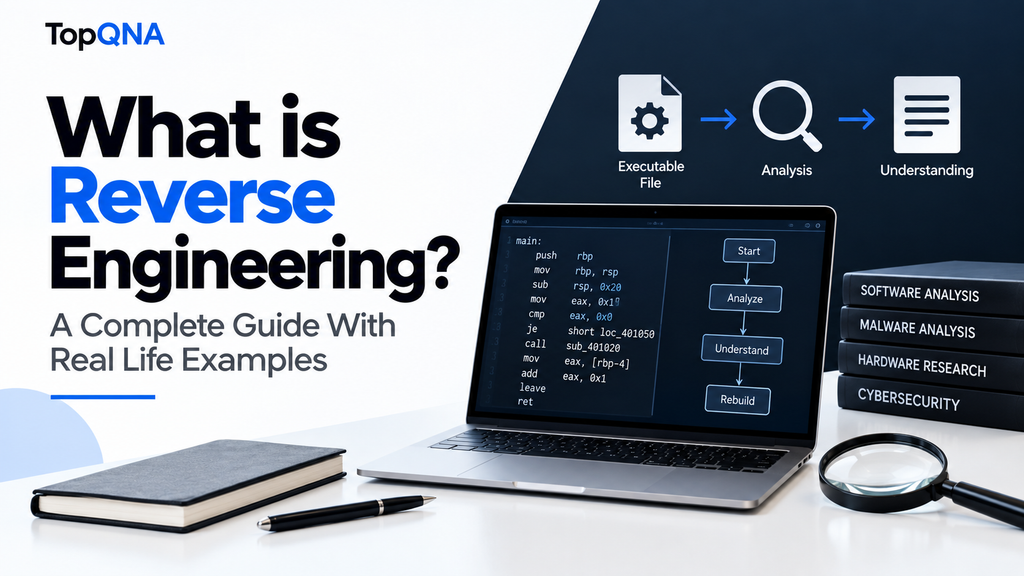
Reverse engineering is the process of examining an existing product, software, device, or system to understand how it works. Instead of building something from the beginning, engineers and researchers start with something that already exists and study its internal structure, components, and behavior.
Reverse engineering is commonly used in software development, cybersecurity, malware analysis, digital forensics, hardware research, and security testing.
A simple real life example is taking apart an old electronic device to understand how its components work together. You may not have designed the device, but by carefully examining its parts, connections, and functions, you can understand how the original device was built.
What Is Reverse Engineering?
Reverse engineering means studying an existing system and working backward to understand its design and functionality.
Imagine you have a mobile application installed on your phone. You can use the application, but you do not have access to its original source code. A security researcher can analyze the application files, functions, instructions, and behavior to understand how the application works.
In simple words, reverse engineering answers questions such as:
• What is this software doing?
• How does this feature work?
• Which components are being used?
• How does the software communicate with other systems?
• How does the device process information?
• Are there any security weaknesses?
A Simple Real-Life Example
Imagine that you buy a digital alarm clock.
You can see the buttons, display, speaker, battery, and circuit board. However, you do not know exactly how the alarm system works internally.
You could carefully examine the clock and identify:
• The battery that provides power
• The circuit board that processes signals
• The buttons that provide input
• The display that shows information
• The speaker that produces sound
By studying these components and their connections, you can understand how the alarm clock works.
This is the basic idea behind reverse engineering.
The same concept can be applied to software, mobile applications, games, websites, firmware, and computer systems.
Forward Engineering vs Reverse Engineering
Forward engineering starts with an idea and produces a working system.
Reverse engineering starts with a working system and works backward to understand it.
Forward Engineering
Reverse Engineering
Starts with an idea
Starts with an existing system
Creates a new system
Studies an existing system
Moves from design to implementation
Moves from implementation to understanding
Source code is usually available
Source code may not be available
Focuses on building
Focuses on understanding
For example, a developer creating a calculator application from scratch is using forward engineering.
A researcher examining an existing calculator application to understand its internal logic is performing reverse engineering.
How Does Reverse Engineering Work?
The exact process depends on what is being analyzed, but the general approach follows a similar pattern.
• Collect the software, device, or system for analysis
For software, researchers may examine executable files, functions, strings, memory, libraries, and network communication.
Software Reverse Engineering
Software reverse engineering focuses on understanding how an application or executable program works.
When a programmer writes an application, they normally work with source code. The source code is eventually compiled into instructions that a computer can execute.
A reverse engineer may start with the compiled program instead of the original source code.
For example, imagine a company has an old desktop application that still works but its original source code has been lost.
A reverse engineer can examine the application to understand:
• What functions it contains
• How it stores information
• Which files it accesses
• How it communicates with other systems
• How different features operate
This information can help the company maintain or rebuild the software.
Real Life Example of Software Reverse Engineering
Imagine an old accounting application used by a business for many years.
The application still works, but the original developers are no longer available and the original documentation is missing.
Instead of completely guessing how the application works, engineers can analyze the executable file.
They may discover:
• How customer records are stored
• How calculations are performed
• How reports are generated
• Which files contain configuration information
• How the application communicates with a database
This can help engineers understand and maintain the legacy application.
Reverse Engineering in Cybersecurity
Reverse engineering is an important skill in cybersecurity because security researchers often need to understand software that they did not create.
For example, suppose a security team discovers a suspicious executable file on a company’s computer.
Simply looking at the file name may not reveal what the program actually does.
Researchers can analyze the program in a controlled environment to understand its behavior.
They may investigate:
• Which files the program creates
• Which processes it starts
• Which system functions it uses
• Which domains or servers it contacts
• What information it attempts to access
• How it behaves during execution
This information can help security teams understand and defend against threats.
Real Life Example of Malware Analysis
Imagine a company discovers an unknown program running on an employee’s computer.
The security team isolates the computer and analyzes the suspicious program in a controlled laboratory environment.
During the investigation, researchers discover that the program attempts to communicate with an external server and modifies certain system files.
By reverse engineering the program, researchers can understand its behavior and create security rules to help detect similar activity.
This is one reason reverse engineering is important in modern cybersecurity.
Types of Reverse Engineering
Reverse engineering can be applied to different areas of technology.
Software Reverse Engineering
Used to understand applications, executable files, libraries, and software components.
Malware Reverse Engineering
Used by security researchers to understand malicious programs and their behavior.
Hardware Reverse Engineering
Used to study physical devices, circuits, chips, and electronic components.
Firmware Reverse Engineering
Used to analyze software embedded inside devices such as routers, cameras, smart devices, and IoT equipment.
Network Reverse Engineering
Used to understand how applications and devices communicate through networks.
Static Analysis vs Dynamic Analysis
Static analysis and dynamic analysis are two important approaches in software reverse engineering.
Static Analysis
Dynamic Analysis
Examines software without running it
Examines software while it is running
Studies code and program structure
Studies real program behavior
Can examine strings and functions
Can observe processes and memory
Does not require execution
Requires controlled execution
Useful for understanding program structure
Useful for understanding actual behavior
Static Analysis Example
Imagine you receive an unknown executable.
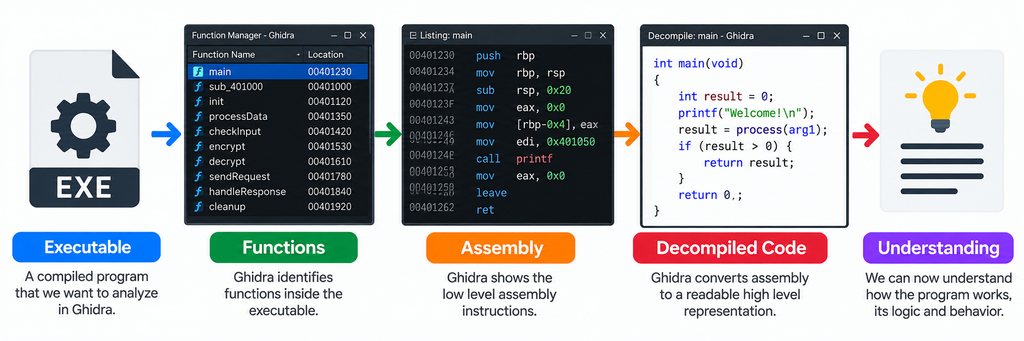
Instead of running it, you open it in Ghidra and examine its functions, strings, libraries, and instructions.
This is static analysis.
Dynamic Analysis Example
Imagine you run the same program inside an isolated virtual machine and monitor its behavior.
You observe which files it creates, which processes it starts, and which network connections it makes.
This is dynamic analysis.
Both approaches can complement each other.
What Is Ghidra?
Ghidra is a free and open source software reverse engineering framework.
It is widely used for analyzing executable programs and understanding how compiled software works.
Ghidra provides several useful capabilities:
• Disassembly
• Decompilation
• Function analysis
• String analysis
• Cross reference analysis
• Debugging support
For example, suppose you have a Windows executable but do not have its source code.
You can import the executable into Ghidra and examine its functions and instructions.
Ghidra may also produce a decompiled representation that is easier for humans to understand.
The result is not necessarily the original source code. It is an analysis of the compiled program.
Other Reverse Engineering Tools
Several tools are commonly used in reverse engineering.
IDA Pro
A professional disassembler and reverse engineering platform used for detailed binary analysis.
x64dbg
A debugger commonly used to examine Windows applications while they are running.
Binary Ninja
A reverse engineering platform designed for analyzing binary programs and understanding their structure.
Wireshark
A network protocol analyzer that can help researchers understand how applications communicate over networks.
Strings
A simple utility that can reveal readable text stored inside many executable files.
Reverse Engineering vs Hacking
Reverse engineering and hacking are related, but they are not the same thing.
Reverse Engineering
Hacking
Focuses on understanding systems
Can involve accessing or testing systems
Studies software and hardware behavior
May involve finding and exploiting weaknesses
Often involves binary analysis
Can involve many different techniques
Used in research and security analysis
Used in security testing and other activities
Does not automatically mean unauthorized access
Authorization is important for legitimate security work
For example, analyzing an application that you have permission to study is reverse engineering.
Trying to access someone else’s computer without permission is unauthorized activity.
Real Life Example in Hardware
Imagine a company wants to understand an old electronic device but the manufacturer no longer provides technical documentation.
Engineers can examine the device’s circuit board and identify:
• Chips
• Connectors
• Memory components
• Power components
• Communication interfaces
By studying these components and their connections, engineers can build a technical understanding of the device.
This can help with maintenance, research, compatibility, or security testing.
Real Life Example in Mobile Applications
Mobile applications are another common area for reverse engineering research.
Suppose a security researcher wants to understand how a mobile application handles sensitive information.
The researcher may analyze the application package and study its:
• Program structure
• Libraries
• Permissions
• Strings
• Network communication
• Data storage
The purpose of authorized analysis can be to identify security weaknesses and improve the application’s protection.
Benefits of Reverse Engineering
Reverse engineering provides several important benefits.
• Helps researchers understand complex systems
• Supports malware investigation
• Helps identify security vulnerabilities
• Assists with digital forensics
• Supports legacy software maintenance
• Helps understand undocumented systems
• Supports compatibility research
• Improves understanding of software behavior
Challenges of Reverse Engineering
Reverse engineering can become difficult when software is large or intentionally designed to make analysis harder.
Common challenges include:
• Complex program structures
• Obfuscated code
• Large executable files
• Missing documentation
• Encrypted data
• Anti debugging techniques
• Complicated memory structures
• Large numbers of functions
A reverse engineer therefore needs patience and a strong understanding of computer systems.
Is Reverse Engineering Legal?
Reverse engineering is not automatically illegal.
Its legality can depend on the purpose of the analysis, ownership, authorization, software licenses, copyright rules, contracts, and applicable laws.
For example, analyzing software that you own or have explicit permission to examine for security research is different from accessing another person’s computer without authorization.
People learning reverse engineering should practice in controlled environments using software, CTF challenges, educational binaries, and systems for which they have permission.
How to Start Learning Reverse Engineering
Beginners can approach reverse engineering gradually.
• Learn computer fundamentals
• Understand how operating systems work
• Learn programming basics
• Study C and C++
• Learn computer architecture
• Study basic assembly language
• Understand memory and processes
• Learn debugging concepts
• Install Ghidra
• Analyze simple educational programs
• Practice static and dynamic analysis
• Explore legal CTF challenges
Programming is particularly useful because reverse engineering requires an understanding of how high level programming concepts become low level machine instructions.
Reverse Engineering Career Opportunities
Reverse engineering skills can be useful in several cybersecurity careers.
• Reverse Engineer
• Malware Analyst
• Security Researcher
• Vulnerability Researcher
• Threat Researcher
• Digital Forensics Analyst
• Malware Researcher
• Application Security Researcher
These professionals may analyze software, investigate vulnerabilities, study malicious programs, or research new security techniques.
Frequently Asked Questions
Is reverse engineering difficult?
Reverse engineering can be challenging because it combines programming, operating systems, computer architecture, assembly language, and debugging. Beginners can learn it gradually by starting with basic concepts.
Is programming necessary for reverse engineering?
Programming is highly useful. C is especially valuable because it helps learners understand memory, pointers, functions, and low level programming concepts.
Which programming language is useful for reverse engineering?
C is an excellent starting point. C++ is also useful for analyzing more complex applications.
How long does it take to learn reverse engineering?
The learning time depends on your background and practice. Basic concepts can be learned relatively quickly, while advanced binary analysis requires continued study and practical experience.
Can beginners learn reverse engineering?
Yes. Beginners can start with computer fundamentals, programming, assembly language, and tools such as Ghidra.
Is Ghidra free?
Yes. Ghidra is a free and open source reverse engineering framework.
Is reverse engineering part of cybersecurity?
Yes. Reverse engineering is used in malware analysis, vulnerability research, digital forensics, application security, and security research.
Conclusion
Reverse engineering is the process of working backward from an existing product, program, device, or system to understand how it works.
It can be compared to taking apart a machine and studying each component to understand how the complete machine functions.
In technology, the same concept is applied to software, hardware, firmware, mobile applications, networks, and computer systems.
Reverse engineering is particularly valuable in cybersecurity because it helps researchers investigate malware, understand suspicious programs, identify vulnerabilities, and improve defensive security.
For anyone interested in learning reverse engineering, a strong foundation in programming, computer architecture, operating systems, assembly language, and debugging provides a solid starting point. Tools such as Ghidra can then be used to turn that theoretical knowledge into practical skills.